NaturesLens guides have been taking small groups out onto Lake Kerkini every January since 2014 – Alison, Pui Hang & David have each led departures here in recent years – & the Dalmatian Pelicans are the reason none of us have ever grown tired of it. There is something about watching a bird with a nine-foot wingspan drift out of the mist on perfectly still winter water, with the snow-capped Beles mountains behind it, that photographers come back to test themselves against again & again. Lake Kerkini in northern Greece is not a place you tick off once. It is a place that keeps drawing serious bird photographers back for a second, third & sometimes fifth visit, because the pelicans, the light & the access keep giving something new. This piece is about why that happens, & what it is about our Dalmatian Pelicans of Lake Kerkini photography holiday that makes repeat visits feel worthwhile rather than repetitive.
Why does Lake Kerkini hold onto its Dalmatian Pelicans so reliably each January?
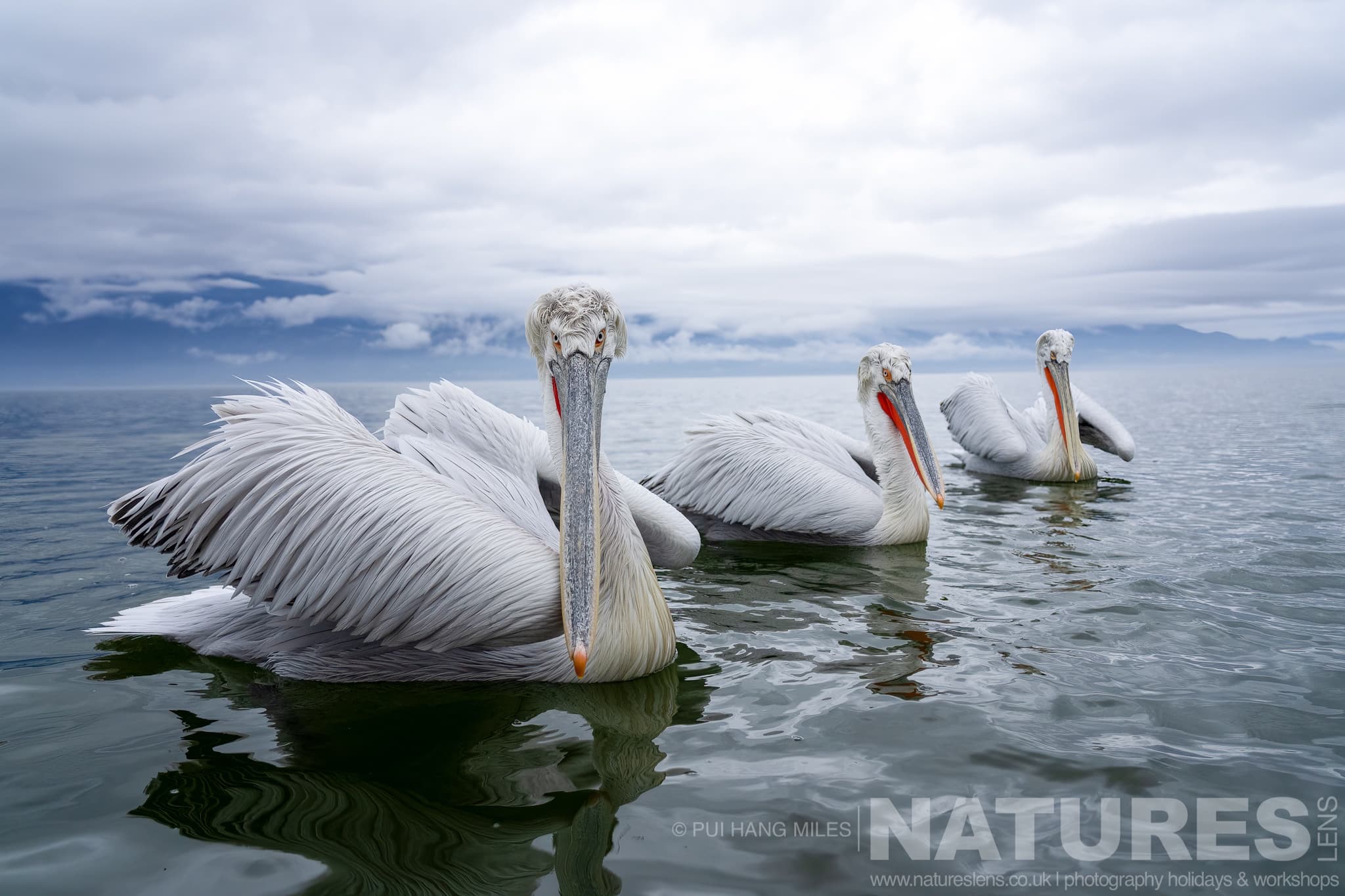
The lake itself is the answer. It was formed early in the twentieth century by damming the Strymonas River, & the reservoir that resulted has matured into one of the most important wetlands in the Balkans, a mosaic of shallow open water, reedbed & seasonally flooded grassland that pelicans simply do not abandon in winter. By January the Dalmatian Pelicans are in full breeding plumage, their shaggy nape feathers catching the low winter sun, & the population congregates here in numbers that make consistent access realistic rather than hopeful. We share the water with Great White Pelicans & the far scarcer Pink-backed Pelican, alongside Pygmy Cormorants working the reed margins & White-tailed Eagles patrolling the open water for an easy meal. Common Cranes & Whooper Swans pass through too, their calls carrying across the mist at dawn. None of that is guaranteed on any single morning, but the consistency of the site across a dozen winters of running this trip is what lets me plan a January departure with real confidence rather than crossed fingers.
Why photograph from a boat rather than working the shoreline alone?
Sitting low in a small boat, at water level, changes the entire relationship between photographer & pelican. Rather than shooting down onto the birds from a bank, which flattens a subject with that much presence, we get eye-level portraits with clean water behind them & the option to work reflections when the surface is calm, which on a still January morning it very often is. Our boatman has worked this stretch of water with us since we first ran the trip in 2014, & that history matters more than it might sound. He reads where the pelicans are feeding, keeps the engine quiet at the right moments & positions the boat so the low winter light sits behind us rather than behind the birds. A photographer with a 400mm to 600mm lens can fill the frame with a portrait one moment & pull back for a group of a dozen birds gliding past the Beles backdrop the next, & that flexibility inside a single boat session is very hard to replicate from fixed ground.
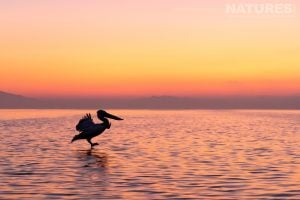
Mornings on the lake in January are genuinely cold, often sub-zero before the sun clears the mountains, & that cold is part of what makes the images work. Breath fogs in front of the lens, mist sits low over the water in thin drifting bands, & a pelican lifting off through that mist with the light just catching its wingtips is the kind of frame that no amount of shoreline patience will hand you. Some mornings the mist burns off within the hour & you are left with hard, clean winter light instead; other mornings it lingers for most of the session. Our guides have learned not to plan around one or the other, because the variation across three or four mornings on the water is exactly what gives a group such a varied set of images to bring home, rather than four repeats of the same conditions.
What does the afternoon shoreline session add that the boat can’t?
Every full day on this trip pairs a morning boat session with an afternoon at the shoreline, where the pelicans are fed close to a fixed platform. This is where behaviour comes into its own: birds jostling for position, wings raised in display, the occasional squabble over a fish, all photographed from a much lower, steadier position than a moving boat allows. It is a different photographic problem entirely, built around backgrounds, timing & anticipating movement rather than composing a portrait against open water. Guests who have been on the trip before tend to use this session differently second time round, having already banked the classic portrait shots from the boat & now hunting for interaction, flight sequences & the split-second moments that only come from familiarity with how the feeding unfolds. That progression, from capturing the obvious shot to working the subtler ones, is a large part of why a second visit rarely feels like repeating the first.
Who tends to get the most from this particular trip?
It suits photographers who want to work a single subject properly rather than collect a long species list. Lake Kerkini is not a general birding tour with pelicans as a bonus; it is built entirely around giving you sustained, repeated time with one exceptional subject in genuinely productive conditions, which is a very different proposition to a sightseeing trip where a guide points out a pelican in the distance & moves on. The group is capped at seven photographers specifically so everyone gets proper space in the boat & individual guidance rather than jostling for position, & the pace suits anyone comfortable with early starts & several cold hours on the water in exchange for the kind of access that simply is not available from the shore. It also suits photographers building a portfolio around a single species in depth, since three full days on the water gives enough variety of light, behaviour & angle to come home with a genuinely rounded set of images rather than one good frame & a lot of near misses.
Why do we keep bringing groups back to the same boatman & the same stretch of water?
Familiarity, in this line of work, is worth more than novelty. We could vary the itinerary each year, try a different bay or a different boat operator, but none of us have found a good reason to when the current setup keeps producing strong images winter after winter. The relationships we have built locally, particularly with a boatman who understands exactly what a group of photographers needs from a session, are the kind of thing that takes years to establish & would be foolish to discard for the sake of change. It is also why the trip has run every January since 2014 with only minor refinements to timing rather than a wholesale rework: when something works this consistently, the discipline is in leaving it alone & trusting the process, not in reinventing it for its own sake. For guests, that translates into confidence that what they are booking has been tested & refined over more than a decade, not assembled for a single season.
So what is it that keeps photographers coming back to Lake Kerkini?
It comes down to a subject that rewards depth over breadth, & a location that has proven, winter after winter, that it can deliver on that promise. Once you have spent three days working Dalmatian Pelicans from a low boat against the Beles mountains, & spent an afternoon watching them squabble & display at the shoreline, you understand how much more there still is to capture: different light, different behaviour, different individual birds catching the frame in a way you have not managed before. That is precisely the kind of destination NaturesLens is built around, & it sits comfortably alongside the wider case for wildlife photography in Greece that we have set out in our piece on why photographers are drawn to Greece. If you would like to know more about the habitat & species you will find at Lake Kerkini, or see availability for a future January departure, get in touch & Alison or David will happily talk you through what to expect from the boat & the season.
What makes a strong Lake Kerkini Dalmatian Pelican photography trip?
The best Lake Kerkini Dalmatian Pelican trips are built around January timing, low boat-based photography, experienced local boat handling, small groups & repeated sessions with the birds rather than a single short visit. NaturesLens has run small-group Lake Kerkini pelican holidays since 2014, using the winter window when Dalmatian Pelicans are in breeding condition & the Beles mountains can give the photographs their distinctive backdrop.
Current NaturesLens Kerkini departures focus specifically on Dalmatian Pelicans & the wider winter wetland setting, with guidance from NaturesLens leaders & enough time to work changing light, behaviour, shoreline sessions & flight opportunities.