You are in the heart of the Maasai Mara, & a Cheetah is perched atop a termite mound, scanning the horizon for gazelle. The light is a soft, buttery gold, & the subject is perfectly sharp. Most photographers would instinctively place the Cheetah’s head dead-centre in the frame, fire off a burst of shots, & move on. The result is a record shot – a clear, sharp document that the animal was there, but an image that lacks soul, narrative, or artistic tension. To take a record shot to portfolio image standard, stop looking at the animal as a subject & start looking at the frame as a canvas.

Composition is the most subjective yet powerful tool in a wildlife photographer’s arsenal. While your camera settings for wildlife photography ensure technical accuracy, composition is what creates an emotional connection between the viewer & the wild. It is the difference between someone saying “That’s a nice cheetah” & “That is a strong piece of art.”
From Record Shot to Portfolio Image: Why Composition Matters
Technical perfection is now the baseline. Modern sensors & autofocus systems have made sharp images easier to achieve than ever before. What separates the serious photographer from the casual observer is the ability to organise the chaotic elements of nature into a coherent, pleasing, & impactful arrangement.
A well-composed image directs the viewer’s eye exactly where you want it to go. It can convey the immense scale of an Elephant in the Chobe or the fragile delicacy of a butterfly in a Bulgarian meadow. Composition allows you to tell a story about an animal’s life, its environment, & its behaviour, rather than just showing what the animal looks like.
Moving Beyond the Rule of Thirds
Every technique below is a practical step from record shot to portfolio image. While the Rule of Thirds is a useful starting point, relying on it too heavily leads to predictable, safe images. To build a first-rate portfolio, master the more advanced concepts of visual weight & balance.
Lead Room & Negative Space
Leave lead room in the direction the animal is looking or moving. If a Wolf in Yellowstone is walking from left to right, placing the Wolf on the left-hand third of the frame creates a sense of journey & purpose. Conversely, tight framing that cuts off the space in front of the animal can create claustrophobia or tension – a technique sometimes used when photographing in low light to emphasise a predator’s intensity.
Negative space – large areas of empty frame like a clear sky or a flat snowfield in Japan – highlights the isolation of a subject. A single Red-crowned Crane positioned at the bottom corner of a vast, white frame creates a far more powerful image than a tight crop of the bird’s head.

The Power of Perspective: Get Low
If there is one technique that consistently separates professional wildlife photography from amateur work, it is perspective. Working from a standing height or the roof of a vehicle is the fastest way to create a flat, uninspiring image. By getting down to the eye level of the animal, you enter their world.
This is why we use sunken hides in places like Shompole or custom-built photography boats on the Chobe River. When you are eye-to-eye with a Lion or a Malachite Kingfisher, the background falls away into a beautiful, creamy blur (bokeh), & the subject gains a monumental presence. The viewer feels like a participant in the scene rather than a distant observer.

Environmental Portraits
Wider framing is another route from record shot to portfolio image, because it adds context a tight crop never can. The instinct for many is to reach for the longest lens possible to get close. Some of the most successful portfolio images, however, are taken with wider focal lengths. An environmental portrait shows the animal within its habitat.
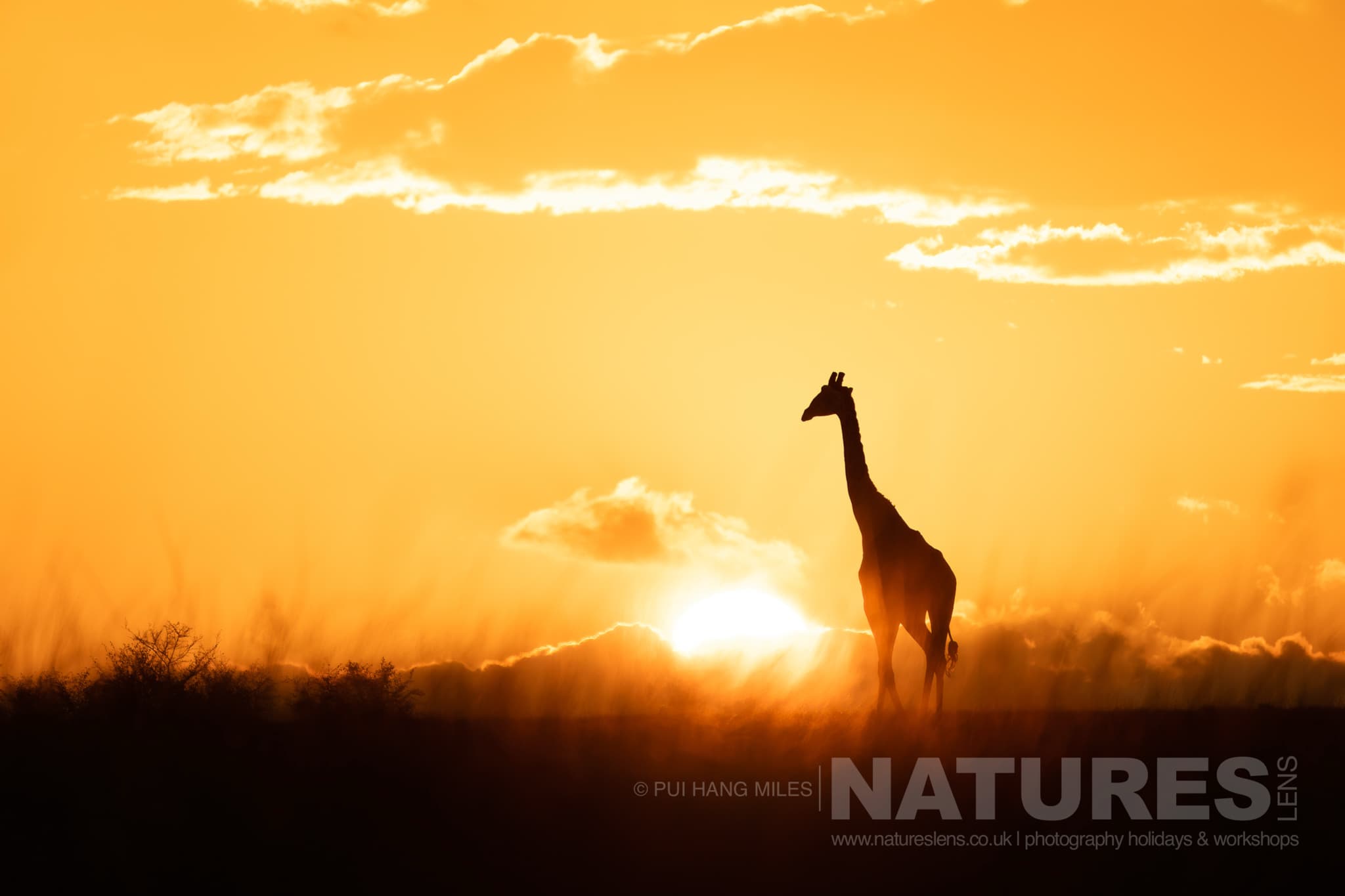
On the vast plains of Tanzania, we often encourage guests to pull back. A tiny silhouette of a Giraffe against a towering thunderstorm or an Acacia tree tells a much larger story about the African wilderness than a close-up of its eyelashes. This requires a different approach to composition in wildlife photography, focusing on how the lines of the landscape lead the eye toward the subject.
Field Examples: Composition in Action
These field examples show a record shot to portfolio image upgrade in practice.
“Frame within a Frame” – Costa Rica
In the dense rainforests, the environment is your enemy – until you make it your ally. When photographing a Resplendent Quetzal, rather than fighting for a clear opening, look for a window of leaves. Out-of-focus foliage in the foreground frames the bird, creating three-dimensional depth that makes the viewer feel like they are peeking through the canopy. This technique is particularly useful for photographing birds in flight as they navigate through forest gaps.

Minimalism & Scale – Northern Sweden
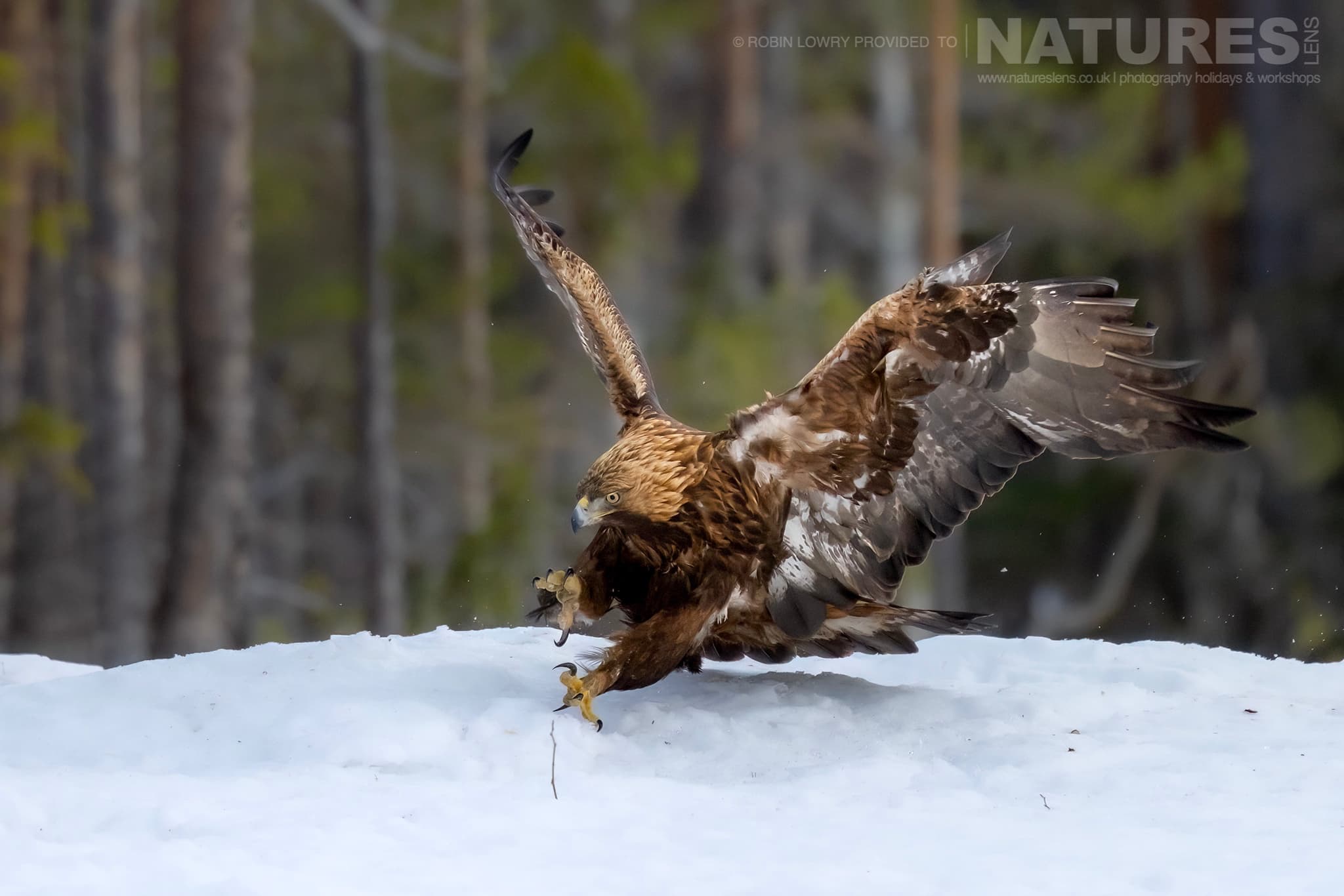
In the subarctic winter, the landscape is stripped of colour & clutter. When a Golden Eagle lands on a frost-covered branch, the composition should reflect that starkness. Use a high-key approach, exposing for the eagle’s dark feathers & allowing the snowy background to go pure white. By placing the Golden Eagle off-centre & embracing the emptiness of the winter sky, you emphasise the bird’s resilience in a harsh environment.
Symmetry & Reflection – Chobe River
Water provides a unique compositional gift: the reflection. On the Chobe, we wait for the moments when the water is like glass. A Hippo or a Lily Trotter with a perfect vertical reflection allows for a symmetrical composition that is deeply satisfying to the eye. Breaking the Rule of Thirds & placing the water line dead-centre can actually strengthen the image, creating a Rorschach-test effect.

Common Compositional Mistakes
The habits below are what most often stop a record shot to portfolio image happening.
- The Bullseye Effect – Placing every subject in the exact centre of the frame. This is the hallmark of a record shot & usually lacks energy.
- Cutting off Extremities – Clipping the tip of a tail, a paw, or a wingtip. In the heat of the moment, especially when learning how to photograph birds in flight, it is easy to choke the subject. Always leave a little extra room; you can crop in later, but you cannot grow a wingtip in post-processing.
- The Cluttered Head – Failing to notice a branch or a blade of grass sticking out from behind the animal’s head. Before you press the shutter, do a border check & look at the immediate area around your subject’s face.
- The Sloping Horizon – In the excitement of a sighting, it is common to tilt the camera. A crooked horizon in a coastal or plains shot is jarring. Many modern cameras have an electronic level in the viewfinder – use it.
How to Improve Your Compositional Eye
Practise the record shot to portfolio image process on every outing, not just when the light is perfect.
The best way to improve is to slow down. When you encounter a subject, do not just start shooting. Ask yourself: what is the story here?
- Work the Subject – If the animal is relaxed, move the vehicle, adjust your tripod height, or shift your position in the hide. A six-inch change in height can completely transform the background.
- Look for Leading Lines – Use roads, animal tracks, or fallen trees to lead the eye toward your subject.
- Check the Background First – A great wildlife image is 50% subject & 50% background. If the background is messy, the shot will not work. Look for pockets of clean light or colour.
- Use Different Focal Lengths – Do not just stay at 600mm. Try a 70 – 200mm to include the environment.
The NaturesLens Advantage
On a NaturesLens wildlife photography holiday, composition is a constant topic of conversation. Our guides do not just tell you what settings to use; they help you see the frame. We position our vehicles & boats not just for proximity, but for the best possible light & background.
Whether we are helping you align a macro shot of a frog in a Bulgarian meadow or advising on the best angle for a Leopard in a tree, our goal is to help you move beyond the mugshot & start creating art. The value of a small-group wildlife photography holiday is most evident here – the one-on-one time allows us to look at your LCD & suggest a compositional tweak that turns a good shot into a portfolio-grade image.

Closing Summary
The path from record shot to portfolio image is a habit, not a talent.
Composition is the bridge between the technical world of optics & the emotional world of art. It requires patience, a keen eye, & a willingness to experiment. By moving beyond the basics, getting low, & embracing the environment, you will find that your images begin to carry a weight & a narrative they never had before.
Join one of our wildlife photography holidays & let’s turn those record shots into a first-rate portfolio.
← Composition & Creative Intent in Wildlife Photography
- NaturesLens trips are designed around photographic opportunity – schedules, positions, & access are all structured to give you the best light.
- Small groups ensure unhurried access & individual guidance, with the maximum group size shown on each trip page.
- Single occupancy is included on the majority of our trips.
Composition
- Composition & Creative Intent in Wildlife Photography
- Composition in Wildlife Photography - From Record Shot to Portfolio Image
- Environmental Context in Wildlife Composition
- Intent in Wildlife Photography - From Reactive Shooting to Deliberate Image-Making