
For wildlife photographers, choosing the right luggage is rarely as straightforward as finding a bag that fits in an aircraft’s overhead locker. When you’re travelling with professional camera bodies, long telephoto lenses, spare batteries, chargers & the various accessories that accompany a serious photographic trip, airline baggage allowances can become one of the more frustrating parts of planning a holiday.
I’ve travelled extensively with photographic equipment, both personally & while leading NaturesLens wildlife photography holidays, & one thing I’ve learned is that there’s surprisingly little consistency between airlines. A camera bag that is perfectly acceptable on a British Airways flight might exceed the permitted weight on Lufthansa, while an apparently generous long-haul baggage allowance can become considerably less useful when your itinerary includes a regional connection.
The solution isn’t necessarily to travel with less equipment, although that’s sometimes sensible. It’s to understand the difference between baggage dimensions, weight allowances & ticket entitlements, then choose a combination of bags that will work for the entire journey rather than just the first flight.
Why Do Airline Cabin Baggage Allowances Matter So Much to Wildlife Photographers?
The biggest concern for most wildlife photographers isn’t the suitcase containing their clothes, but the camera equipment they would much rather keep with them throughout the journey. A long telephoto lens can represent a considerable investment, & when you add two camera bodies, a second lens, batteries, memory cards & accessories, the value of what’s inside a relatively ordinary-looking camera bag can be substantial.
Personally, I tend to travel with Sony camera equipment, including Sony A1 II bodies & lenses such as the 400mm f/2.8 GM, 300mm f/2.8 GM & 100 – 400mm GM. Not every trip requires the same selection, but even a carefully chosen combination can produce a surprisingly heavy bag before I’ve added a laptop or anything else.
The problem is that airlines don’t apply a universal standard. British Airways currently permits a cabin bag measuring up to 56 × 45 × 25cm, whereas Lufthansa’s standard cabin bag dimensions are 55 × 40 × 23cm with an 8kg weight limit on applicable fares. Those differences might seem insignificant until you’re trying to accommodate a large camera backpack that is already close to the permitted dimensions.

Another consideration is the distinction between a cabin bag & a smaller personal item. Some airlines permit both, while others include only the smaller bag with their basic fares. More importantly, the fact that a bag fits within an airline’s published dimensions doesn’t guarantee that it will remain in the cabin. Airlines can require larger cabin bags to be placed in the hold when overhead locker space is limited.
For that reason, I think photographers should approach baggage planning in much the same way they approach deciding which lenses to take into the field. The aim is to have the equipment you genuinely need, properly protected & accessible, without discovering at the boarding gate that you’ve overlooked a restriction.
How Do Cabin Baggage Sizes & Weight Limits Differ Between Airlines?
One of the reasons I started keeping a reference list of airline baggage allowances was the difficulty of comparing carriers when planning international photographic trips. Looking at the published figures, the differences between airlines are immediately apparent, particularly when weight restrictions are considered alongside the physical dimensions.
The table below gives some useful examples of published standard or eligible cabin baggage allowances. These are not necessarily included with every fare, & personal-item permissions should always be checked separately.
| Airline | Larger cabin bag | Weight limit |
|---|---|---|
| British Airways | 56 × 45 × 25cm | Up to 23kg |
| easyJet | 56 × 45 × 25cm | 15kg |
| Lufthansa | 55 × 40 × 23cm | 8kg |
| Ryanair | 55 × 40 × 20cm | 10kg |
| Air France | 55 × 35 × 25cm | Fare-dependent |
| KLM | 55 × 35 × 25cm | Fare-dependent |
| Qatar Airways | 50 × 37 × 25cm | Typically 7kg in Economy |
| Emirates | 55 × 38 × 22cm | Typically 7kg in Economy |
Indicative dimensions & weight allowances from published airline guidance, reviewed October 2026. Eligibility, fare class, route & operating carrier may affect what you can actually carry.
British Airways is particularly accommodating when it comes to weight, although you must still be able to lift your cabin bag safely into the overhead locker. Our British Airways carry-on rules guide covers the detail. easyJet also permits relatively substantial cabin bags, but the larger bag must be purchased separately or included through an eligible fare or membership. Ryanair similarly allows a larger cabin bag through its Priority & 2 Cabin Bags option.
For photographers, there’s another distinction worth understanding. Some airlines specify a weight allowance for each bag, while others apply a combined allowance to cabin baggage & personal items. That can make the apparently useful option of dividing equipment between a backpack & smaller shoulder bag less straightforward than it first appears.
I would always recommend checking the allowance attached to the actual ticket before booking, rather than relying on a general comparison table. Also check the aircraft’s operating airline on codeshare services, because the carrier you book with isn’t always the one whose baggage restrictions will apply.
The full range of allowances across airlines is simply too varied for any static table to remain completely accurate indefinitely, which is why the airline’s own published policy should always be the final authority.
What Type of Camera Bag Is Best for Travelling With Long Telephoto Lenses?
The ideal camera bag is one that protects your equipment, meets the restrictions of the airlines you’re using & remains practical once you reach your destination. Unfortunately, those three requirements don’t always lead to the same choice.
I’ve used a variety of photographic luggage over the years, including Peli cases & Think Tank backpacks, & there’s a considerable difference between a bag designed primarily for transporting equipment through airports & one intended to be carried around in the field. My Peli 1510 & 1535 cases provide the reassurance of rigid protection, while a photographic backpack such as the Think Tank Airport Accelerator offers a different balance of capacity, access & portability.
The Airport Accelerator is the bag I keep returning to, & I explain why in my Think Tank Airport Accelerator review after 12 years of use. For journeys where wheels make more sense than straps, I also use Peak Design luggage, including the Roller Pro Carry-On, the Travel Backpack 45L & the Travel Weekender 25L. Each suits a different kind of journey, & I’ve compared them side by side in our full camera bag & travel luggage comparison.
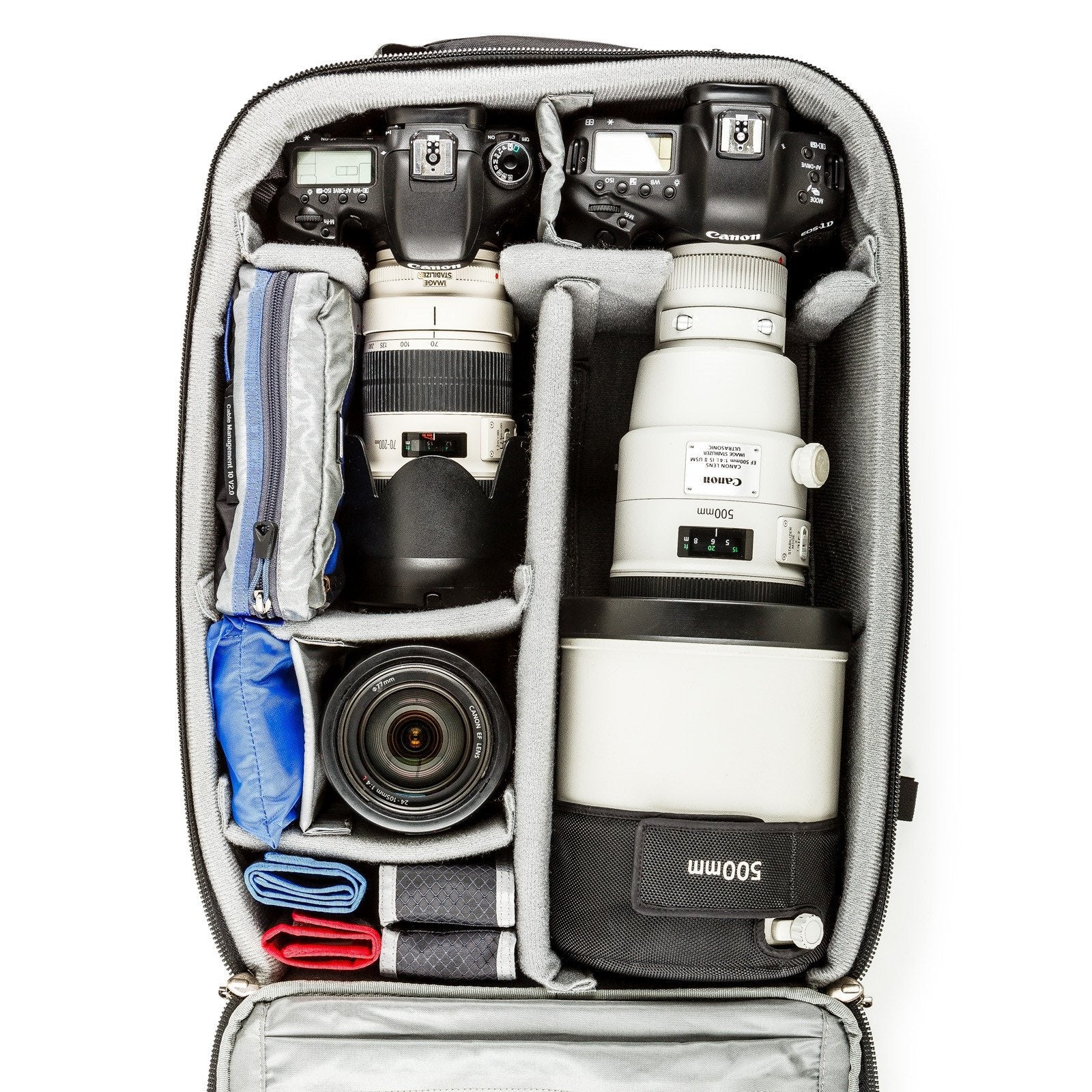
One point that frequently gets overlooked is the weight of the empty bag. A hard case can consume a meaningful proportion of an airline’s cabin allowance before you’ve placed a single camera inside it. If the airline limits cabin luggage to 7kg or 8kg, the protection provided by a rigid case might come at the expense of how much equipment you can legally carry.
You also need to consider the actual external dimensions, rather than simply relying on a manufacturer’s description of something as cabin approved. Handles, wheels, reinforced corners & external pockets all count towards the airline’s dimensions. A bag that is acceptable on one carrier may be several centimetres too deep for another, regardless of how neatly the equipment fits inside.
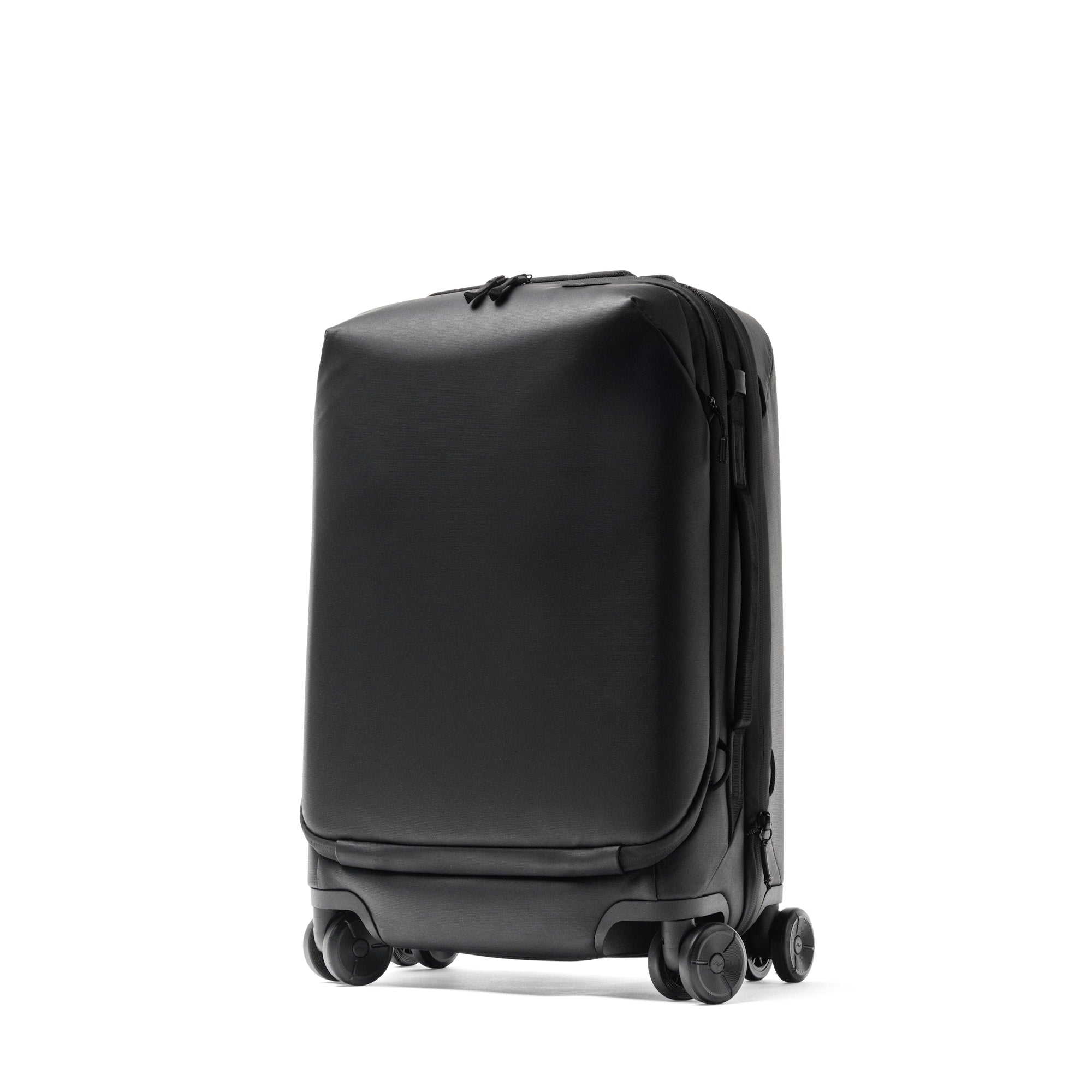
The nature of the photographic trip matters as well. For a winter photography holiday in Japan, where I might be working with substantial telephoto equipment in cold conditions, I want to protect that equipment during the journey while retaining flexibility once I’m photographing Red-crowned Cranes or Steller’s Sea Eagles. On a rainforest trip in Costa Rica, I might favour a different arrangement that makes it easier to move between locations & manage equipment in humid conditions.
I would therefore choose the bag around the equipment & the journey, rather than buying the largest case advertised as suitable for air travel & assuming it will work everywhere.
How Should Photographers Manage Hold Luggage & Regional Flight Restrictions?
Checked luggage generally offers considerably more flexibility than cabin baggage, although photographers should still pay close attention to weight limits, oversized equipment & the restrictions imposed by any connecting flights.
Many international airlines use a standard checked-baggage allowance of around 23kg per suitcase in Economy, although the number of bags included, the maximum permitted weight & the charges for additional luggage vary considerably. There’s also an important difference between purchasing additional baggage weight & purchasing an extra bag. If an airline permits 23kg per piece, buying another allowance doesn’t necessarily mean you can pack 46kg into one suitcase.
For wildlife photographers, regional flights can introduce an additional complication. This is particularly relevant when travelling in parts of Africa, where smaller aircraft may operate between international gateways & wildlife areas. Depending on the operator, luggage may be restricted to approximately 15kg in total, with soft-sided bags required because of the limited space available in the aircraft’s baggage compartments. These restrictions must always be confirmed for the particular flight.
When we’re planning photographic itineraries in destinations such as Kenya, the logistics of transporting cameras, long lenses, tripods & personal belongings deserve just as much consideration as the international flights. The last thing anyone wants is to discover that their equipment can reach Nairobi comfortably but cannot travel onwards under the arrangements they’ve booked.
The same principle applies when planning photography holidays involving domestic connections in Japan or journeys between destinations in South America. The baggage allowance advertised for the long-haul sector isn’t necessarily the allowance available for the entire itinerary.
I would also avoid checking anything that is genuinely irreplaceable for the trip unless there is no reasonable alternative. Clothing, non-essential accessories & appropriately protected tripods are easier to accommodate in checked luggage. Camera bodies, important lenses, memory cards & equipment containing valuable photographic work deserve considerably more thought.
What Camera Equipment & Batteries Should Never Be Packed in Checked Luggage?
One area where photographers really do need to understand the regulations is lithium batteries. These are subject to aviation safety rules that apply independently of the ordinary baggage allowance, & getting them wrong can cause problems at airport security or boarding.
Spare lithium-ion camera batteries & power banks must travel in cabin baggage, with their terminals protected against short circuits. Batteries installed in cameras are treated differently from loose spares, but I would still prefer to carry my camera bodies in the cabin wherever possible. International Air Transport Association guidance also recommends keeping electronic devices with you, rather than placing them in checked luggage.
Most ordinary camera batteries fall comfortably below the 100Wh threshold, but photographers using larger external battery packs need to check their ratings carefully. Under IATA’s 2026 guidance, batteries between 100Wh & 160Wh may require airline approval, while certain larger batteries are prohibited from passenger baggage altogether. Power banks have their own restrictions, including limits on quantity, so it’s important not to assume that every item using a lithium battery is treated identically.
I would also recommend keeping memory cards, portable SSDs & at least one backup of your photographs in your cabin luggage. On our Essential Costa Rican Wildlife photography holiday, for example, there can be opportunities to photograph everything from small hummingbirds to frogs & other rainforest wildlife in dramatically different conditions. Losing access to your equipment is frustrating, but losing the photographs you’ve already taken would be considerably worse.
One practical precaution I particularly recommend is having a small removable pouch containing batteries, power banks, memory cards & other essentials. If your larger cabin bag unexpectedly has to travel in the hold, you can remove restricted items quickly rather than attempting to reorganise the entire bag at the boarding gate.
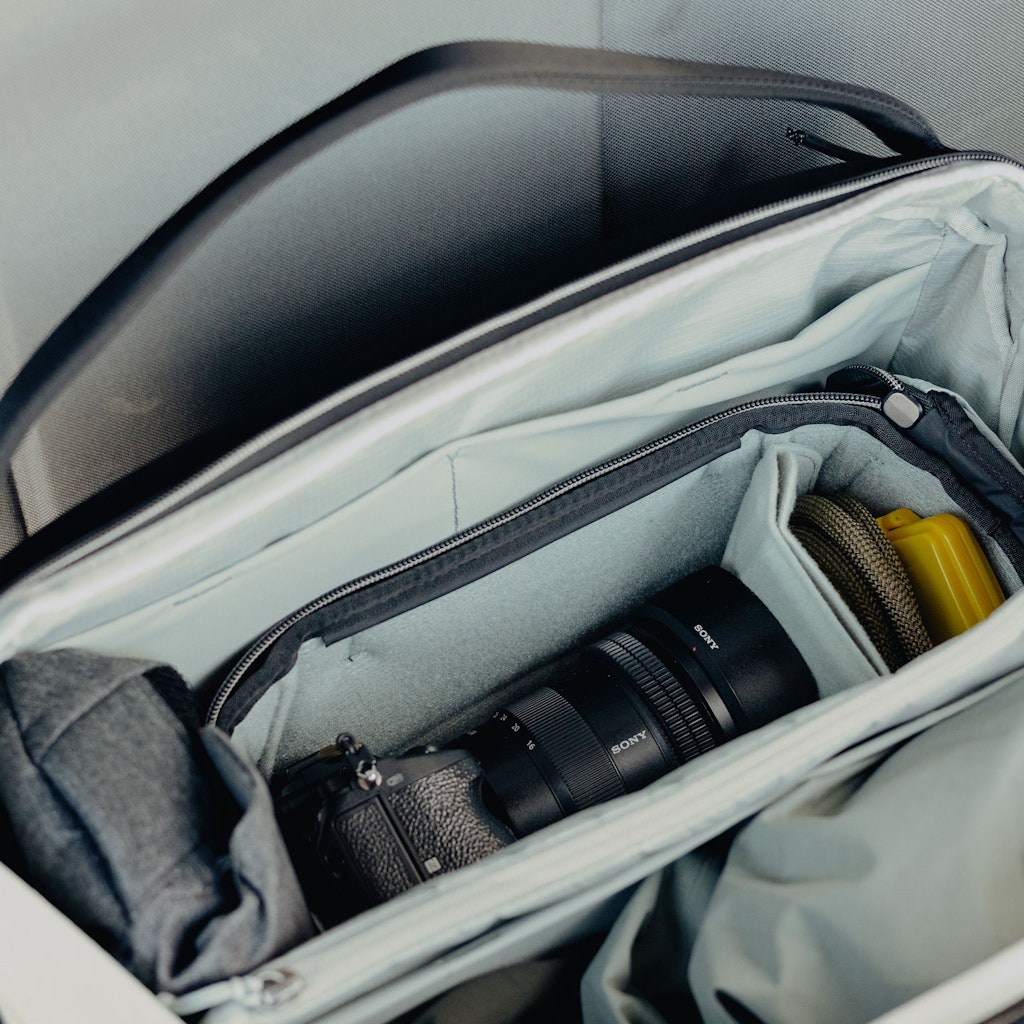
For me, protecting photographic equipment also means thinking beyond physical damage. Insurance cover, equipment inventories, serial numbers & having important photographs backed up separately should all form part of the planning process.
How Can You Choose the Right Baggage Allowance Without Compromising Your Photography?
The best approach is to work backwards from the photographic opportunities rather than forwards from the airline’s maximum baggage allowance. Decide which equipment will genuinely improve the photographs you’re hoping to make, identify what you can reasonably leave behind, & then make sure your chosen baggage arrangement satisfies every part of the journey.
On a trip concentrating on birds in flight, for instance, I might prioritise a fast telephoto lens, a second camera body & enough flexibility to react quickly when a subject moves. On a macro-focused trip, the priorities will be different, with space needed for close-up equipment, flash accessories or other specialist items. There’s little photographic benefit in carrying additional equipment if it contributes nothing to the images you intend to make.
I also think photographers sometimes underestimate the advantages of travelling with a little spare capacity. Rain covers, warm clothing, gloves, chargers & other practical accessories have to go somewhere, while the equipment needs to remain accessible once the journey is over.
It’s worth weighing the entire camera bag at home, fully packed, rather than estimating how heavy the individual pieces might be. Measure its external dimensions when packed as well, because a heavily filled backpack can become considerably deeper than its nominal dimensions suggest.
If you’re flying with several airlines, plan around the most restrictive relevant allowance rather than the most generous. Where legitimate additional cabin baggage, a more suitable fare or specific equipment carriage arrangements are available, investigating those options before booking can be worthwhile.
Ultimately, travelling with photographic equipment is about making considered compromises. At NaturesLens, our itineraries are built around spending meaningful time photographing wildlife rather than racing between locations to accumulate the largest possible species list. That approach gives us the opportunity to concentrate on light, backgrounds, behaviour & positioning, but it also means choosing the equipment that will make the most of those opportunities.
I’d much rather travel with a carefully selected combination of cameras & lenses that I know I’ll use than arrive with an unnecessarily large collection of equipment that becomes difficult to transport, manage or access.
Understanding baggage allowances before travelling is simply another part of preparing properly for a wildlife photography holiday. When the equipment is protected, the flights are organised & everything arrives where it should, we can concentrate on what really matters: getting out into the field, spending time with our subjects & creating the strongest photographs possible.
Once the baggage is sorted, the fun part begins: browse all our wildlife photography holidays, or get in touch if you would like advice on what to pack for a specific destination.