Suomussalmi sits deep in Finland’s eastern taiga, close enough to the Russian border that the brown bears working this landscape move freely between the two countries, & our Brown Bears of Finland photography holiday, based at Viiksimo & guided by Johnny Södergård since 2016, has become the trip a remarkable number of guests come back to for a second or third July. Working from a network of forest hides overlooking meadow, lake edge & taiga tree line, this is photography built around genuine patience rather than a guaranteed encounter, & that honesty is exactly what keeps people returning. This is about why bears in this particular corner of boreal forest are worth going back for.
Why does Viiksimo hold such a reliable brown bear population?
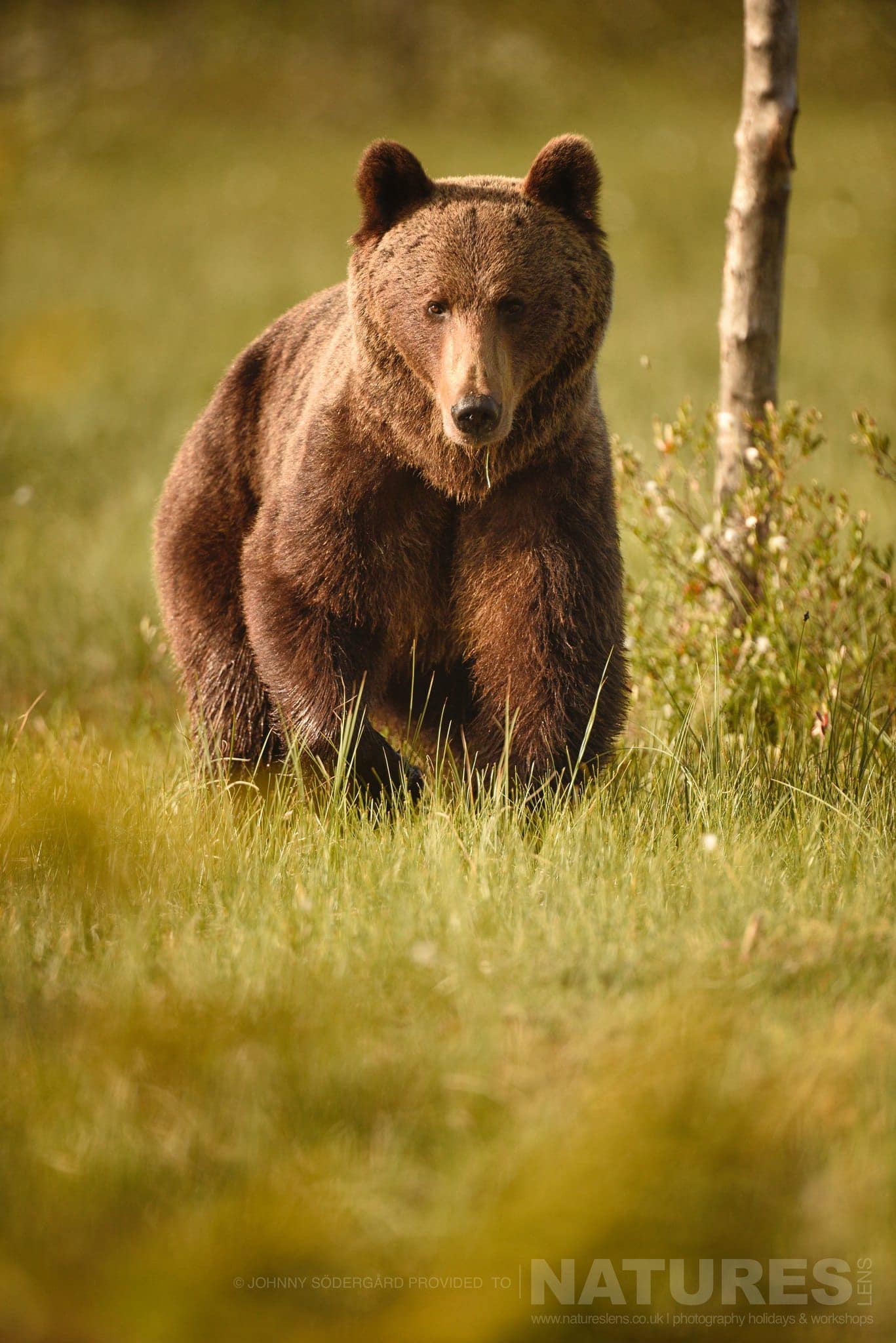
The forest around Viiksimo forms an unbroken corridor of taiga running east into Russia, & that connectivity, largely undisturbed & rich in the berries, ants & carrion bears rely on through summer, is what makes this specific stretch of border forest so consistently productive for Brown Bear sightings. Hides here are positioned overlooking open meadow & lake margins where bears regularly come to feed & drink through the long July evenings, & Johnny’s years of working this exact ground mean the hides sit precisely where bear activity concentrates rather than simply where access happens to be easiest.
Why does July’s near-endless light change how the sessions work?
This far into Finland’s boreal zone in midsummer, true darkness barely arrives at all, & that near-continuous light stretches the working day into something closer to a single extended session than the sharply bounded dawn & dusk windows further south demand. A bear emerging from the tree line at what would be midnight further south can still be photographed in a soft, dusky pink glow, cotton grass lit low & warm across the meadow, & that unusual quality of light, sustained for hours rather than minutes, is one of the more distinctive rewards of working this far north in summer.
Why does hide discipline matter more here than almost anywhere else?
Sessions run long, often through a full night in the hide without disturbance, since bears here are wild, wary animals & the slightest noise or movement at the wrong moment can end a promising approach before a bear ever comes close enough to properly photograph. That sustained stillness, watching a meadow edge for hours before anything happens, is as much a part of what this trip teaches as any specific camera technique, & it is a discipline that transfers directly to hide-based photography anywhere else in the world. The reward, when a large male finally ambles out of the taiga & wades into the shallows of one of Viiksimo’s lakes, his reflection breaking cleanly across still water, makes the wait feel entirely worthwhile.
Wolverine turns up at these same hides with genuine regularity, hurtling past at a speed that catches most photographers off guard the first time, & a resident population using the same forest edge means a returning guest often arrives already knowing roughly when & where a wolverine sighting is most likely, sharpening their reaction time considerably on a second visit. Wolf sightings are rarer, a genuine border-forest specialist that only occasionally shows itself at the hides, but Johnny has recorded enough sightings over the years that a wolf is never entirely out of the question, & that possibility adds a current of anticipation to even the quietest sessions.
What does the wider taiga forest add beyond the bears themselves?
White-tailed Eagle works the airspace above the lakes, occasionally drawing the attention of gulls determined to see it off, & the forest’s quieter residents, Red Squirrel working the hide surroundings & the boreal specialist birds moving through the pines, give a session something to focus on during the inevitable stretches when the meadow itself sits empty. Female Goldeneye leading chicks across still morning water, mist still lifting off the lake, is a gentler, more intimate subject entirely removed from the scale of a bear encounter, & it is exactly the kind of detail that guests on a repeat visit increasingly make time for once the pressure of securing a first bear image has already been satisfied. Crested Tit & other boreal specialists move through the pines around the hides in the early morning quiet, giving a small, close subject to work while waiting for the meadow to properly wake up, & that habit of using the slower stretches productively rather than simply waiting is something every guide on this trip actively encourages.
Why does returning to the same hides change what a guest actually captures?
A first visit to Viiksimo is dominated, understandably, by the sheer novelty of a wild brown bear at close range, & most guests leave that first trip satisfied simply to have secured a clean, well-lit portrait. Return for a second or third July, though, & the conversation in the hide shifts noticeably toward behaviour & composition, working a mother with cubs moving together through the cotton grass, catching the exact moment a bear pauses to scratch against a tree, or waiting specifically for the golden, low-angle light that only holds for a couple of hours even during a long midsummer evening. Johnny has watched that shift happen with guest after guest, & it is precisely why he tailors a returning guest’s hide placement differently to a first-timer’s, prioritising the angles & light that reward patience over the more straightforward, front-on encounters a first visit is built around.
Who tends to get the most from this particular trip?
It suits photographers who are genuinely comfortable with long, still hide sessions & who understand that a bear encounter, however likely, is never guaranteed on any single night. The group is kept small, between four & five photographers, essential for keeping hide sessions quiet enough not to compromise a sighting, & it particularly suits anyone who has found more conventional wildlife-watching trips too fast-paced, since this is a discipline built entirely around sustained patience rather than covering ground.
So what keeps photographers returning to Suomussalmi?
It is the combination of a genuinely wild, undisturbed bear population & light that, this far north in July, simply behaves differently to anywhere further south, stretching a single evening into hours of workable colour. That instinct sits alongside the wider case we make for wildlife photography in Finland in why photographers are drawn to Finland, & you can read more about the region’s habitat & species in our field guide to Suomussalmi. If you would like to talk through a July departure, get in touch & Johnny will explain what the hides are producing this season.