Costa Rica is where many photographers discover what tropical photography is capable of. Our Ultimate Costa Rican Wildlife Photography Tour & Wildlife Icons of Costa Rica Photography Tour are built around exactly that – productive feeders, accessible subjects, the quetzal, the toucan, the tree frog. You come home with a portfolio & a new understanding of what a camera can do in warm light … & then you start wondering what else is out there.
Colombia, Trinidad, Brazil & Peru are the answer to that question. Not a different type of trip – a deeper version of the same obsession. More species, more specialist moments, more of the subjects that make tropical bird photography genuinely extraordinary. & at the centre of all four, the same pull that Costa Rica introduced you to: hummingbirds.
Costa Rica has around fifty hummingbird species. Colombia has a hundred & sixty-five. That number alone tells you something about the step up these destinations represent.
- Colombia – 1,900+ bird species; Minca & the Sierra Nevada cloud forest; the highest hummingbird diversity in the world.
- Trinidad – Asa Wright veranda feeders, the Oilbird cave, Caroni Swamp Scarlet Ibis at sunset; exceptional endemics & neotropical specials.
- Brazil – the Atlantic Forest of the Serra Gauçha combined with Pantanal lowland species; two distinct ecosystems in one trip.
- Peru – Machu Picchu cloud forest meets Manu lowland rainforest; hummingbird species density unmatched anywhere in South America.
What Makes Colombia the Hummingbird Capital of the World?
No country on earth has more bird species than Colombia. More than nineteen hundred at the last count – & that number keeps rising. For tropical bird photographers, this is not a statistic. It is an invitation.
Our Ultimate Birds of Colombia photography tour moves through cloud forest & highland habitats on the eastern & western Andes slopes, where species diversity peaks in ways that are genuinely difficult to prepare for. The endemics alone – birds found nowhere else on earth – would justify the trip. But it is the hummingbirds that most photographers come back talking about.

One hundred & sixty-five species. In a single trip you can photograph fifteen, twenty, sometimes more – each one distinct. The Sword-billed Hummingbird, with a bill longer than its own body, feeding at flowers that only it can reach. The Booted Racket-tail, its leg feathers white & extravagant, hovering long enough for you to study every detail. The Violet-tailed Sylph, its tail a flash of colour so extraordinary it barely looks real.
Costa Rica introduced you to hummingbirds. Colombia shows you what hummingbirds actually are.
What you leave with is a hummingbird portfolio of a depth & variety that is simply not possible anywhere else. Not a handful of the same two or three species you see at every feeder – a collection of subjects, each requiring different technique, different timing, different light. A body of work that, spread across a lightbox, looks like the work of someone who has spent years in the field rather than a week in a single country.
What Does Trinidad Offer Beyond Costa Rica’s Tropical Photography?
Trinidad is a different kind of extraordinary.
It is not about sheer numbers. It is about a handful of moments – each one completely unlike anything available in Costa Rica, or anywhere else – concentrated into a compact, accessible island that rewards patient, considered photography.
Our Tropical Birds of Trinidad photography holiday is based at the Asa Wright Nature Centre, a lodge so legendary among tropical bird photographers that it barely needs describing. The veranda alone – where hummingbirds, honeycreepers & tanagers come to feeders within metres of where you’re sitting – produces images that visitors describe as the most effortlessly productive photography session of their lives. Effortless, but not easy. The subjects are close. The light is good. The challenge is choosing which frame to make next.
But Trinidad’s real trump card is what Asa Wright holds beyond the veranda – Dunston Cave. The only accessible colony of Oilbirds in the Caribbean. A species that echolocates in the dark, nests in cave walls, & produces images so unusual – birds in near-darkness, in rock, in absolute otherness – that photographers who have made them struggle to describe the experience without sounding slightly unhinged.
Then, in the late afternoon, Caroni Swamp. The Scarlet Ibis coming in to roost – hundreds of them, then thousands, turning the mangroves from green to burning red as the light drops. It is one of the great wildlife spectacles on earth, & it photographs like one.
What you leave with from Trinidad is three portfolios in one: the intimate feeder photography of Asa Wright, the genuinely alien oilbird cave, & the Scarlet Ibis sunset. None of them look like Costa Rica. None of them look like each other.
Why Does Brazil Deliver Two Completely Different Rainforest Experiences?
Brazil’s rainforest is not a single thing. It is a continent-scale ecosystem that shifts & changes across hundreds of kilometres of Amazonian basin – & our Birds of Brazil photography holiday is built specifically to show you two distinct versions of it in a single itinerary.
Two rainforest environments. Each with its own character, its own light, its own species mix. What stays constant is the density & the diversity – the sense that the forest is alive in every direction & that what comes into your frame next is genuinely unpredictable.
Hummingbirds are here too, but Amazonian hummingbirds are different from the cloud forest & highland species of Colombia & Peru. Fork-tailed Woodnymphs. Black-throated Mangos. Rufous-breasted Hermits moving through low vegetation on curved wingbeats. Each one requires you to work differently – lower, slower, with more attention to background & less to the perfectly lit perch that feeders provide.
This is photography that pushes you. The subjects are extraordinary. The habitats are extraordinary. & the images you come back with – rainforest portraits, canopy silhouettes, species most wildlife photographers have never attempted – represent a genuine progression from the structured, feeder-based tropical photography that Costa Rica does so well.
What you leave with is a body of work made in one of the most biodiverse environments on the planet, with a species list that has very little overlap with anything you’ve photographed before.
Why Does Peru Take Hummingbird Photography to Another Level?
Northern Peru is, for hummingbird photographers, what Japan is for crane photographers. A place you come to for one subject & find it exceeds every expectation you arrived with.
Our Peru’s Ultimate Hummingbirds photography tour moves through cloud forest & Amazonian habitats on the eastern slopes of the Andes – an altitudinal gradient so rich in hummingbird species that the trip is built specifically around working it systematically. Dozens of species across a single itinerary. Natural flowers & specialist setups. Conditions that allow both the patient controlled frame & the spontaneous behavioural moment.
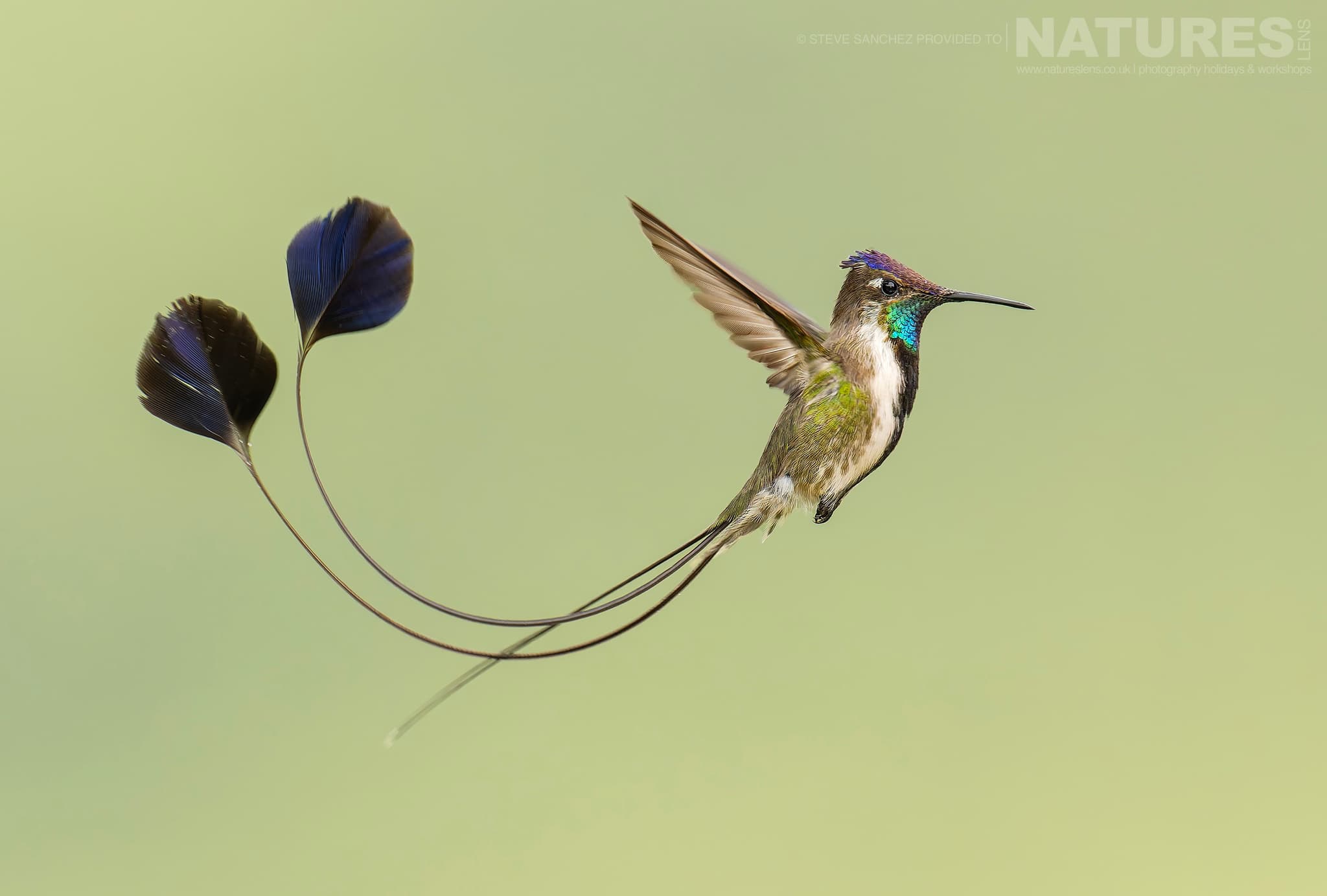
At the heart of it, in a single valley in northern Peru that you cannot access from anywhere else, the Marvelous Spatuletail.
A hummingbird with two outer tail feathers that extend four times the length of its body, crossing below it & ending in violet-blue discs that the male moves independently as it displays. The Marvelous Spatuletail exists in one place. It looks like nothing else in the natural world. The first time you see it in flight you will check your camera to make sure you actually captured it – & then you’ll want to make the image again, better.
That is what Peru does. It takes your understanding of hummingbirds – built in Costa Rica, deepened in Colombia – & shows you how far it can still go.
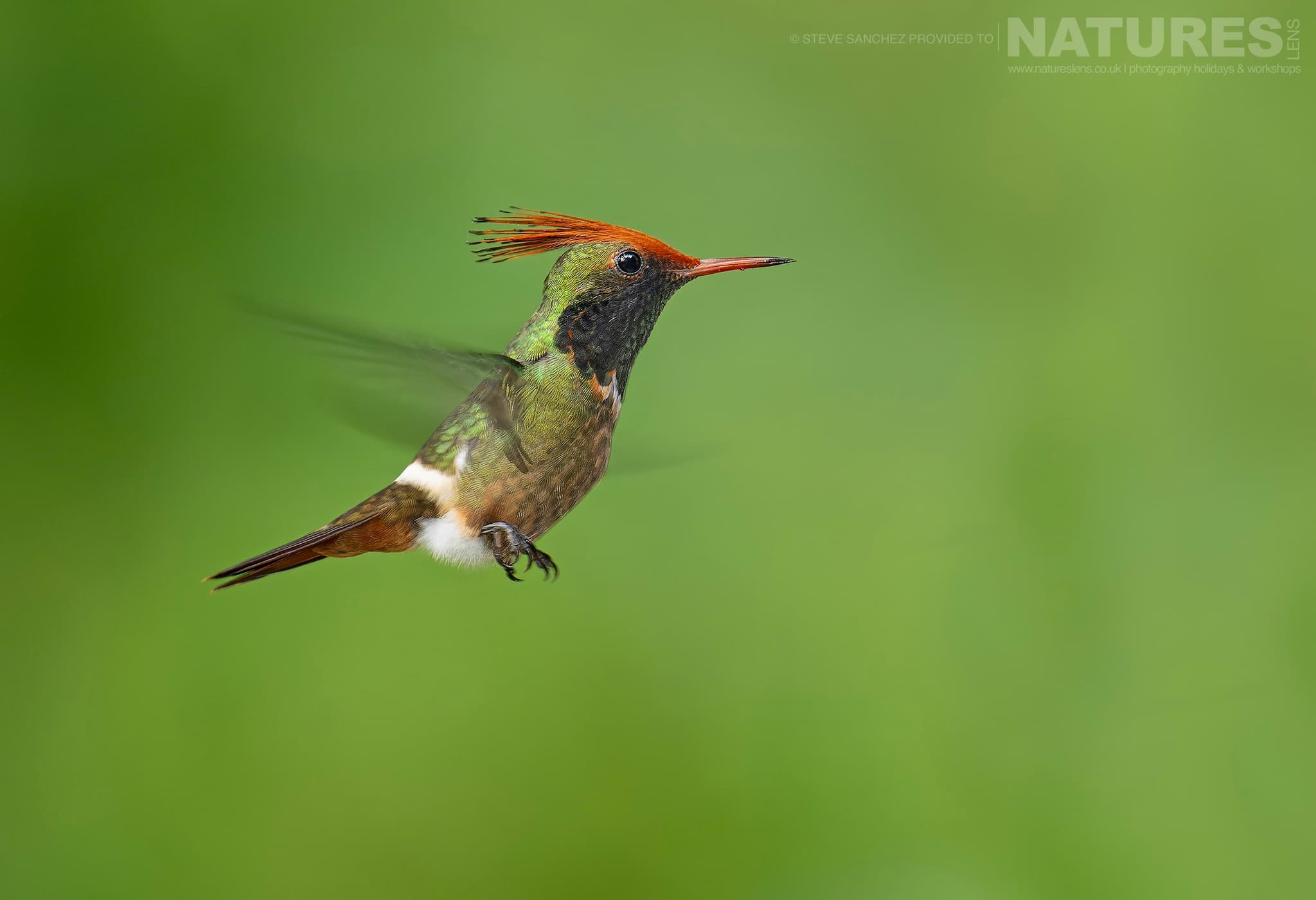
What you leave with from Peru is a hummingbird portfolio of extraordinary depth, made in cloud forest light & Amazonian shadow, anchored by a species that photographers travel from every continent to photograph. It is the natural end point of a journey that Costa Rica begins.
How Do These Destinations Form a Natural Progression from Costa Rica?
Costa Rica is the introduction. These four destinations are what comes after – for photographers who have caught the tropical bug & want to go deeper into it.
Colombia for scale & variety. Trinidad for moments that exist nowhere else. Brazil for rainforest in its most immersive, unpredictable form. Peru for the hummingbird that makes everything you’ve seen before seem like a rehearsal.
They are not harder trips for the sake of it. They are richer ones – for photographers who are ready for what that richness demands.
Hummingbird Photography - A Guide
- Beyond Costa Rica - The Birds of Peru, Colombia, Brazil & Trinidad
- NaturesLens trips are designed around photographic opportunity – schedules, positions, & access are all structured to give you the best light.
- Small groups, normally four to six photographers, ensure unhurried access & individual guidance, with the exact maximum shown on the trip page.
- Single occupancy is included on virtually all NaturesLens trips.