The best wildlife photography trips at Shompole in Kenya are the ones built around the hides themselves, because almost everything that makes this corner of the southern Great Rift Valley special happens beside two waterholes between late afternoon & the following morning. Shompole Wilderness sits within the community-owned Shompole Conservancy, close to the Tanzanian border & between Lake Magadi & Lake Natron, where the Maasai protect the land through conservation-focused tourism, & it gives photographers something I have not found anywhere else in Africa: purpose-built, ground-level hides that open straight onto the night, with lighting designed for photography & a steady procession of lions, leopards, elephants, hyenas & far smaller nocturnal animals coming to drink.
We scouted Shompole in 2024, ran two trips there in 2025 & now return every October on our Shompole wildlife photography holidays, so what follows is a practical guide to what separates a genuinely photographic week from a night or two of hide time added to a longer Kenyan itinerary.
What makes Shompole different from other wildlife photography destinations in Kenya?
Most photography in Kenya is organised around the vehicle, with the day divided into game drives & the quality of a sighting depending largely on where the driver can position the group, whereas at Shompole we stop moving & let the wildlife come to us. The camp sits beneath acacia trees on the banks of the Ewaso Ng’iro River, with spacious en-suite tents, shaded verandas & the calm, family-run atmosphere that suits a week built around resting through the heat of the day, & beyond it the landscape opens into plains, volcanic escarpments & quiet riverine pockets beneath the steep wall of the Nguruman Escarpment, with almost no light pollution & very little vehicle disturbance.
That remoteness shapes the wildlife as much as the photography, because the animals using the waterholes are doing so naturally rather than being baited to the hides, which means the cast on any given night is genuinely unpredictable & the encounters keep the quality of wild behaviour. Over a week the recorded visitors have included lion, leopard, elephant, buffalo, spotted & striped hyena, giraffe, zebra, wildebeest, African civet, genet, African wildcat, white-tailed mongoose, porcupine & bat-eared fox, alongside owls & the occasional surprise such as caracal or serval, & I find that this mixture of grand subjects & small elusive ones is exactly what a nocturnal portfolio needs. It is a very different proposition from the rest of our wildlife photography holidays in Kenya.

Why do the Plains Hide & the Kichaka Hide produce such different photographs?
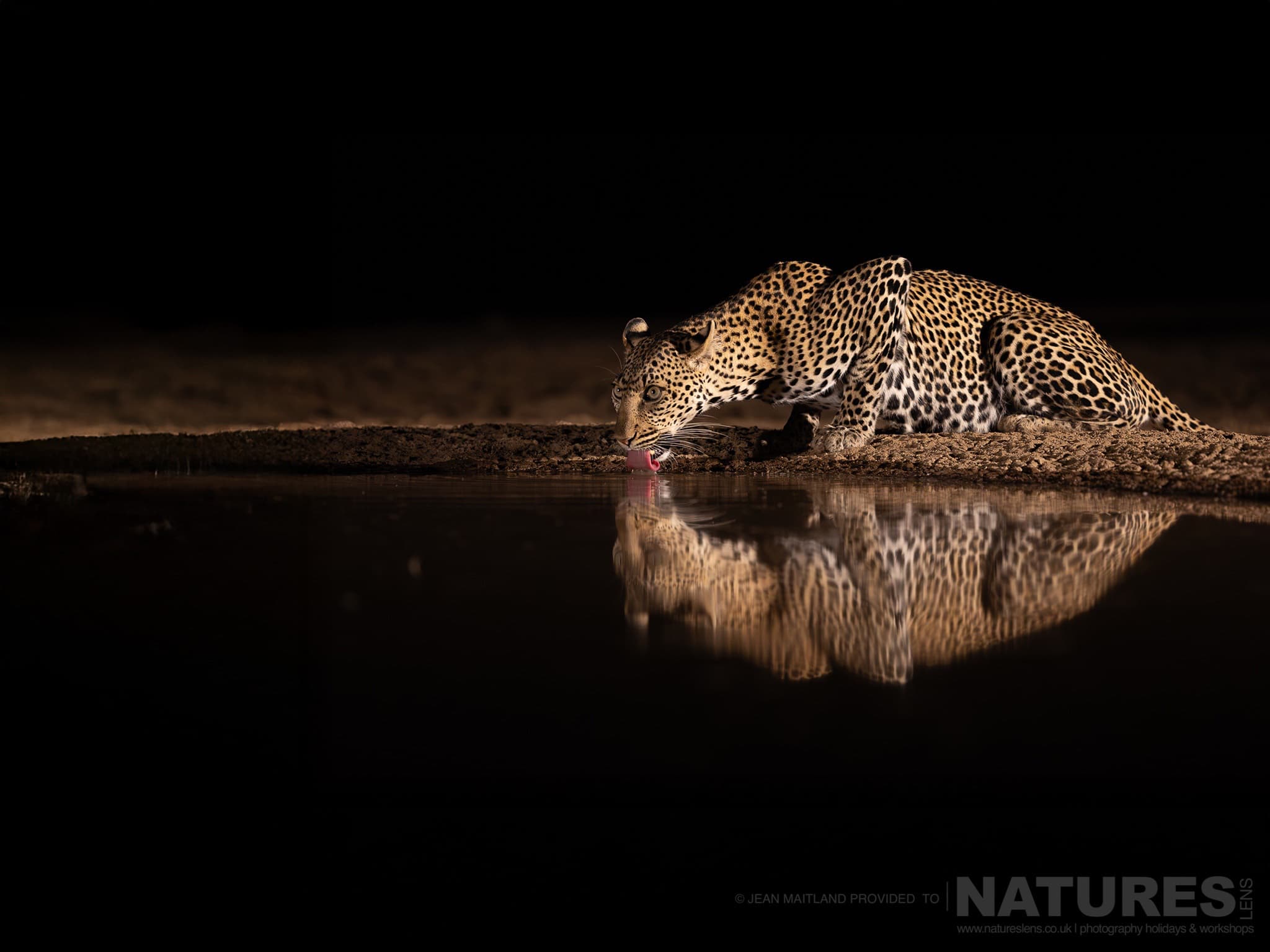
The two hides are deliberately different, & alternating between them across a week is what turns a run of good nights into a varied portfolio. The Plains Hide overlooks an open waterhole in a clearing & is sunk into the ground so that we are photographing at water level, with the far side of the pool only around ten metres from the photographic windows. Those windows are open rather than glazed, so nothing sits between the lens & the animal, which keeps the images optically clean but also means that quiet is essential, because sound carries a long way at night. This is where the larger drama tends to unfold, with lions, leopards, elephants, buffalo & giraffes arriving to drink, & because the water comes right up to the hide, reflections become part of almost every composition.

The Kichaka Hide sits roughly 1.5 kilometres away in thicker vegetation, & it asks for a completely different approach. The encounters are quieter & closer, with African wildcats, civets, mongooses & porcupines moving through the cover, the occasional hyena or leopard slipping past, & lighting that is softer & beautifully suited to portraiture & fine detail. Photographing an animal at eye level rather than looking down on it from a vehicle is one of those small changes of position that transforms the result, & I would much rather give a group a proper run of nights in each hide than hurry between them.

How does controlled lighting change what you can photograph after dark?
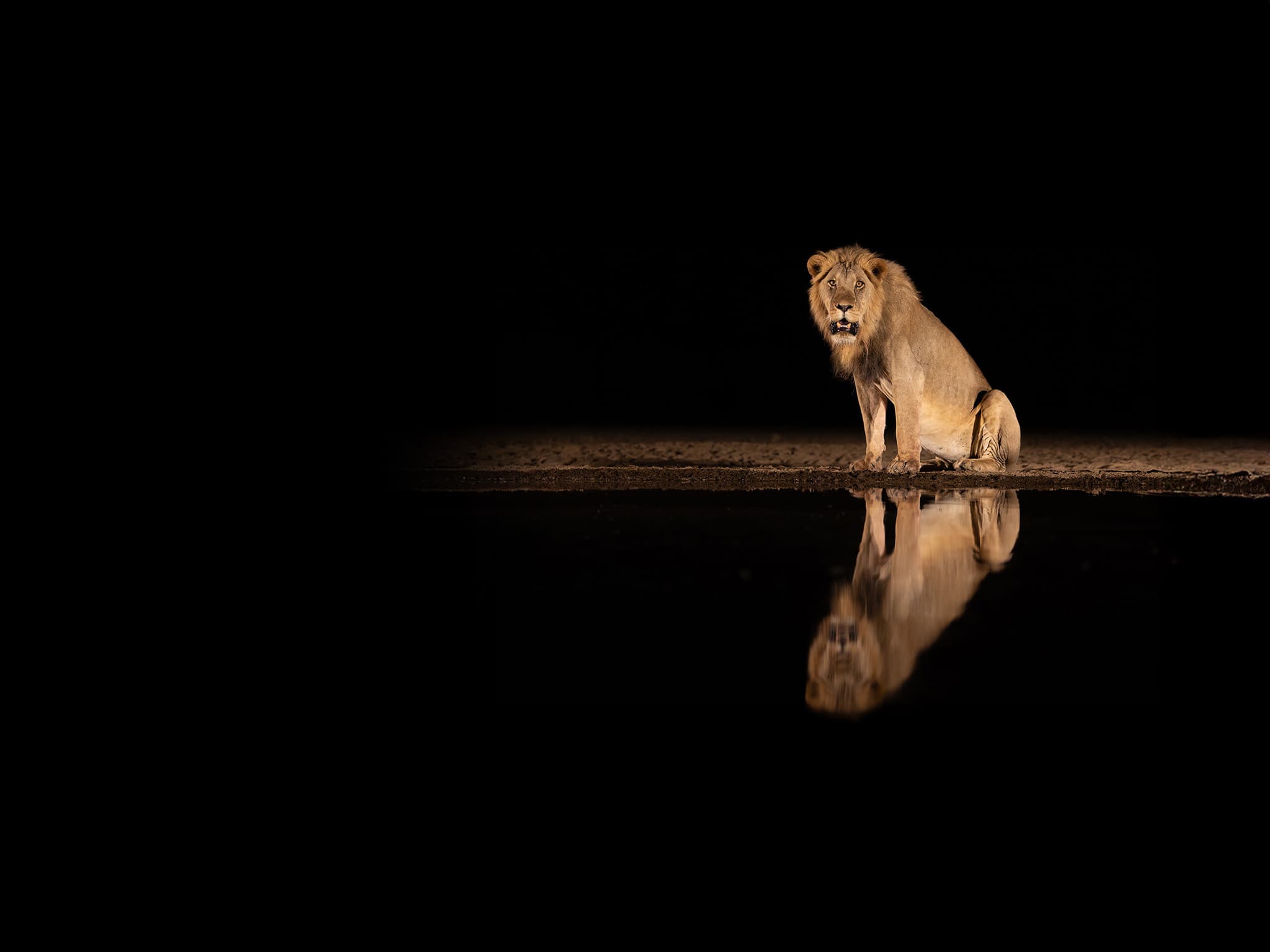
The lighting is what lifts Shompole beyond simply raising the ISO & photographing whatever wanders into a beam, because the Plains Hide has dimmable front, side & back lighting around the waterhole, which means the same subject can be interpreted in three quite different ways. Front lighting reveals colour, expression & the texture of skin, side lighting introduces shape & sculpture, & backlighting can reduce an animal to a glowing outline, rim-lighting a lion’s mane, the edges of an elephant’s tusks or the dust it kicks into the air. When we wrote up our October 2025 week, the Plains Hide was the only hide in the conservancy with backlighting, although both hides had excellent front & side illumination.

What I enjoy most is that darkness becomes part of the composition rather than a problem to be overcome. We can expose for the lit parts of an animal & let everything else fall away into black, leave generous negative space around a small subject, or deliberately underexpose to preserve atmosphere rather than trying to make night look like day, & some of the strongest frames reveal remarkably little, perhaps a line of light along a lion’s back or a pair of eyes reflected in the water. Because the lighting is installed & balanced for photography, the ISO values stay practical, & in my experience a 70-200mm lens on a gimbal does most of the work.

What does a week at Shompole look like in practice?
A NaturesLens week at Shompole runs for seven nights, six of them full nights in the hides, with the group limited to seven photographers & single-occupancy accommodation included. Sessions begin in the late afternoon, when giraffes, zebra & wildebeest often arrive first & glow in the last of the golden light before the hide lighting takes over, & they continue through the night until about nine the following morning, with evening meals taken in the hide as simple, home-cooked dishes that suit the pace of the work. Some nights are hushed & others pulse with activity, & one of the things I like about the format is that a single species will sometimes linger for hours while on other nights there is a procession of visitors until dawn.

The days are for rest, because nobody can concentrate through a night in a hide on no sleep, so most of us spend them over a long breakfast beneath the trees, editing, or photographing sunbirds, hornbills, starlings & weavers at the camp’s bird hide, which keeps the cameras busy without demanding much energy. We supply gimbals & beanbags, so a tripod is unnecessary, & the compact kit that works best is a 70-200mm as the workhorse, a 24-70mm or wide-angle lens for environmental frames, & perhaps a 300mm for tighter portraits.

How should you choose between the different ways of photographing Shompole?
Shompole has become popular enough to appear in several itineraries, & the most useful question to ask is how many full nights you will actually spend in the hides, because the unpredictability that makes the location so rewarding also means that a single night can be wonderfully rich or surprisingly quiet. Some trips include Shompole as two or three nights within a longer Kenyan itinerary, which can suit photographers who want daytime reserves alongside the hides, whereas a dedicated week gives time to work both hides, to return to a productive scene on a second night & to build the varied set of portraits, reflections, rim-lit silhouettes & small nocturnal subjects that a short visit rarely allows. Group size matters just as much, since the number of genuinely good shooting positions in a hide is limited, & I would ask any operator how many photographers share each one.

Our own Wildlife of Shompole Wilderness photography holidays run in October, with departures on the 3rd to 10th & 12th to 19th of October 2027 & again in October 2028, & the week can be combined with our African Wildlife of the Maasai Mara trip for conventional daytime safari. Compared with other nocturnal hide locations, I have found that Zimanga offers more limited overnight access, while Lentorre has a much smaller range of nocturnal wildlife, which is why, in my experience, nowhere else in Africa rivals Shompole for this kind of work.

Why is Shompole worth building a wildlife photography holiday around?
For me the answer is that Shompole produces photographs that do not look like another set of African safari images, & it does so without compromising the wild character of the encounter, because the animals decide whether to come to the water & we simply wait. It suits photographers who are comfortable with patience & stillness, who are happy to sit quietly beside a single waterhole for hours in exchange for a handful of exceptional encounters, & who would rather spend time with a productive subject than collect the longest possible list, whereas it is less suited to anyone who wants landscapes, daytime variety or a quick succession of sightings.

If an elephant arrives & gives us forty minutes of good light, I want us to work it properly, first reflected in the water, then with side light, then wider as it approaches & finally backlit as the dust rises, because that is how a single encounter becomes a varied set of images, & it is the thinking behind what we call an image-first holiday. When I sit in the Plains Hide at 2 am & hear an elephant approaching in near silence, or watch a leopard slide from shadow into light, I understand why these images feel earned, & you can read how a full week unfolds in our account of one week at Shompole Wilderness. If you would like to talk through the dates, get in touch & Pui Hang or I will explain how the hide sessions work.
African Safari
- What Are the Best Wildlife Photography Trips at Shompole in Kenya?
- How Does Photographing Shompole Compare With the Maasai Mara?