There are places in Africa where I have enjoyed extraordinary wildlife encounters, places where the density of animals, the landscapes or the sheer variety of species make photography a wonderful experience. Yet, after years of photographing wildlife across the continent, I can honestly say that Shompole Wilderness offers something quite different, largely because it changes almost everything about the way we approach photographing African wildlife.
Most African safaris revolve around searching for animals, positioning a vehicle & making the most of whatever opportunities present themselves. At Shompole, we turn that approach almost completely on its head. We settle into purpose-built photographic hides, often before sunset, & remain there throughout the night, allowing wildlife to come to us on its own terms.
What makes the experience particularly special is the combination of ground-level photography, carefully controlled lighting, an extraordinary variety of nocturnal species & the opportunity to spend extended periods photographing animals that are rarely encountered under such favourable conditions.
Having first scouted Shompole in 2024, followed by operating NaturesLens photography holidays there, I have come to appreciate just how different the resulting images can be from those produced on a conventional African safari.
What Makes Photographing Wildlife at Shompole So Different from a Conventional African Safari?
The biggest difference is that we are no longer relying on a vehicle to find wildlife or determine our photographic position. Instead, the animals approach our waterholes naturally, often coming within just a few metres of the cameras, while we photograph from a position remarkably close to their eye level.
Shompole Wilderness lies within the Maasai-managed Shompole Conservancy in southern Kenya’s Great Rift Valley, between Lake Magadi & Lake Natron, with the Nguruman Escarpment providing an impressive backdrop to the surrounding plains. It is a remote, comparatively undisturbed landscape, where wildlife moves freely between open grasslands, acacia woodland & thicker bush.
On a conventional safari, even with an excellent driver, we remain constrained by tracks, the position of the vehicle & the direction in which an animal happens to be facing. We might find a leopard in a tree, but have little influence over the background, or encounter a lion in wonderful light only to discover that the vehicle cannot move into a better position.
At Shompole, many of those compromises disappear. The photographic position is already established, with the waterholes placed in front of specially constructed hides, allowing us to concentrate on composition, behaviour & light rather than continually searching for our next subject.

Another important distinction is that the animals are completely wild & are not baited to attract them. They visit the waterholes because they need to drink, which means we cannot predict precisely what will appear or when.
That uncertainty is part of the attraction. A quiet period can suddenly become an extraordinary photographic session when an elephant, leopard or lion emerges from the darkness, sometimes offering compositions that would be almost impossible to achieve from a safari vehicle.

Why Does Photographing Wildlife at Ground Level Make Such an Enormous Difference?
One of the first things that struck me about Shompole was how dramatically the perspective changes when the camera is positioned at approximately the same height as the animals drinking.
The Plains Hide is constructed below ground level, with its photographic openings overlooking a waterhole just metres away. Instead of photographing down towards an animal from the elevated position of a safari vehicle, we are looking directly across the water, which creates a much more intimate relationship between the subject & its surroundings.
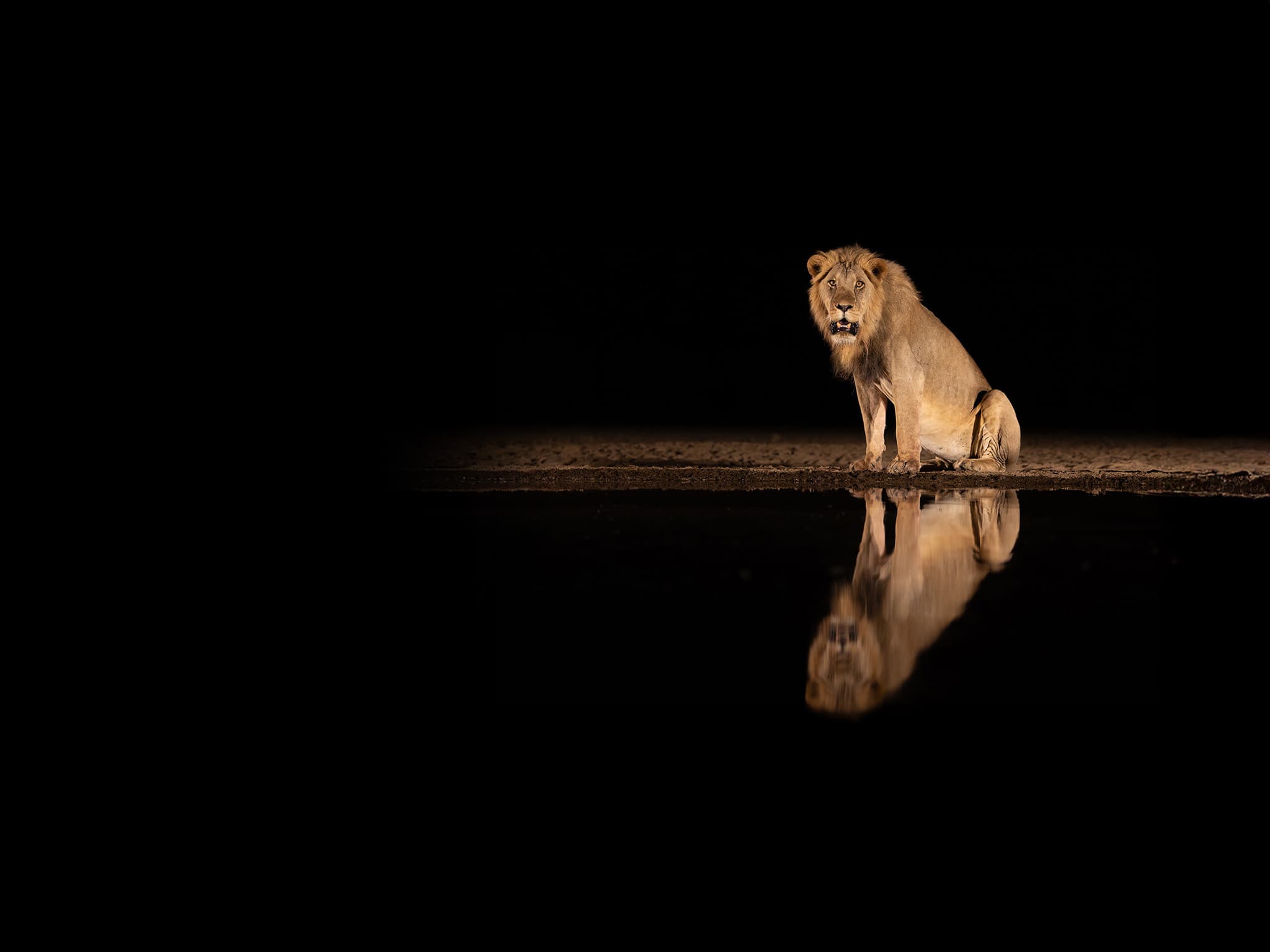
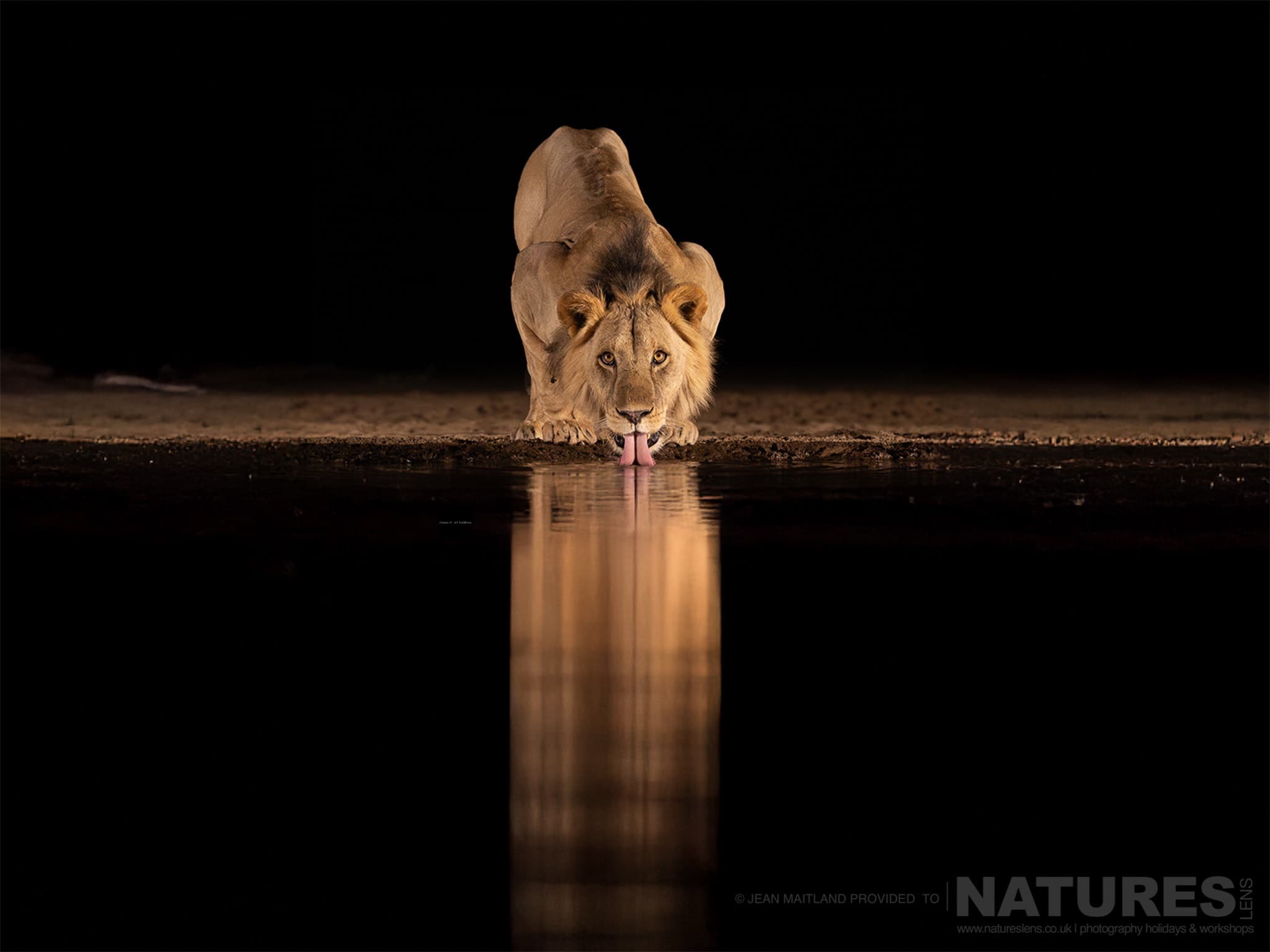
This makes an enormous difference to the resulting photographs, particularly when larger mammals approach. An elephant photographed from ground level appears imposing in a way that an image taken from above rarely achieves, while a lion drinking directly opposite the hide can produce a remarkably engaging portrait, especially when its reflection is visible beneath it.
The water itself becomes an important compositional element. Depending on the animal’s position, the available light & the movement across the surface, we can photograph complete reflections, tightly framed portraits or wider compositions that use the dark surroundings to isolate the subject.

I particularly enjoy having the freedom to experiment with focal lengths that would not necessarily be my first choice on a conventional safari. A 70 – 200mm lens is remarkably useful here, while a wider lens can produce dramatic environmental photographs when a large animal approaches the waterhole.
There is another benefit that becomes apparent after several nights. Because we are waiting at a fixed location rather than following animals, we have time to anticipate how a subject might move through the scene, prepare compositions in advance & consider exactly how we want to photograph it.
That opportunity to think about the photograph before the animal arrives is something I value enormously, especially when working with species that might otherwise give us only a few seconds of visibility.
How Does Shompole Make Photography Possible in the Middle of the Night?
For me, the most remarkable aspect of Shompole is that some of the best photographic opportunities occur when it is completely dark, at times when conventional wildlife photography would ordinarily have finished hours earlier.
The hides use specially designed lighting systems that illuminate the waterholes without attempting to make the entire surrounding landscape visible. At the Plains Hide, front, side & backlighting create a range of photographic possibilities, allowing us to work with different interpretations of the same animal.
Front lighting is particularly useful when we want to reveal the detail in a leopard’s coat, the texture of an elephant’s skin or the expression of a lion looking towards the camera. Side lighting produces a different effect, revealing shape & depth, while backlighting can create some of the most atmospheric wildlife images I have encountered.
A lion standing against a completely black background, with the edges of its mane illuminated, is an entirely different photographic proposition from the same animal resting in daylight. An elephant walking through dust can become an almost abstract composition when the light catches the particles around its body.

What I find especially rewarding is that darkness becomes something we actively use rather than something we are trying to overcome. Instead of increasing exposure until the photograph resembles daylight, we can embrace the black surroundings, allowing the subject to emerge from them naturally.
The installed lighting makes this possible without relying on a photographer’s flash for every exposure, although careful attention to shutter speed, aperture & ISO remains essential, particularly when animals are moving.
It also encourages a completely different way of seeing wildlife. A small movement, a reflected eye or the suggestion of an animal emerging from shadow can be every bit as compelling as a perfectly illuminated portrait.

Why Do the Two Main Photographic Hides Offer Such Different Opportunities?
Although the Plains Hide is perhaps the better-known of Shompole’s photographic locations, I think the opportunity to work between the Plains Hide & the Kichaka Hide is one of the strongest reasons for spending an entire week here.
The Plains Hide occupies a comparatively open environment, where the waterhole attracts an impressive variety of larger mammals. Elephants, giraffes, zebra, buffalo, lions & leopards are among the species recorded visiting, creating opportunities for dramatic compositions against open backgrounds.
The Kichaka Hide, approximately 1.5 kilometres away, occupies a more enclosed, bushier habitat, where the photographic atmosphere is noticeably different. The surrounding vegetation creates a more intimate environment, particularly suitable for smaller nocturnal mammals such as African civet, common genet, porcupine & various mongoose species, although larger predators can also make appearances.

This difference in habitat matters photographically because it changes the backgrounds, the way animals approach & the types of photographs we can produce. A leopard at the Plains waterhole might lend itself to a dramatic reflection, whereas a smaller mammal emerging from the vegetation at Kichaka can make a beautifully atmospheric portrait.
It also adds an important element of variety to the holiday. I would never want our guests to spend an entire week producing slightly different versions of essentially the same image, however impressive the subject might be.
By alternating between the hides, we can build a portfolio that includes large mammals, elusive nocturnal species, detailed portraits, wider environmental compositions & photographs using very different lighting conditions.

That variety was one of the reasons we decided to structure our Wildlife of Shompole Wilderness photography holiday around repeated, extended sessions rather than treating the hides as a short addition to a conventional safari.
Why Is Spending Entire Nights in the Hides Better Than Visiting for a Few Hours?
Wildlife rarely follows the timetable we would prefer, which is why our Shompole holidays are designed around six full nights of hide photography during a seven-night stay.
Sessions generally begin in the late afternoon, when there is still natural light & species such as giraffe, zebra or antelope may visit the waterholes. As darkness falls, the lighting systems take over, & the photographic experience changes completely.
Some nights become productive quite early, while others require considerably more patience. An animal might appear shortly after sunset, disappear into the darkness & not return for several hours. Equally, a species we have been hoping to photograph might arrive at two or three in the morning, when anyone following a more conventional schedule would be asleep.

This is why I am reluctant to build a photography holiday around only one or two nights at Shompole. The wildlife is unpredictable, & repeated sessions allow us to experience different conditions, different species & sometimes entirely different behaviour.
Patience is particularly important when an animal remains close to the waterhole. Rather than taking a handful of photographs & moving on, we can concentrate on subtle changes in posture, head position, reflections & the relationship between the subject & the lighting.
The daily routine is necessarily different too. After returning from the hides in the morning, we have breakfast & spend much of the day resting, reviewing photographs or enjoying the quieter surroundings of Shompole Wilderness Camp. There is also a smaller bird hide at camp for those who want further photographic opportunities without undertaking another demanding outing.
We limit our groups to seven photographers, with single-occupancy accommodation included, because the experience depends on having sufficient space, quiet conditions & the opportunity for everyone to work comfortably.
It requires a willingness to adjust one’s sleeping pattern, but the rewards can be extraordinary.
Who Will Get the Most from a Wildlife Photography Holiday at Shompole?
I think Shompole is particularly well suited to photographers who have already experienced a conventional African safari & are looking for something that will produce genuinely different images, although previous African wildlife photography experience is certainly not essential.
The important thing is the mindset with which you approach the experience. If your main objective is to see as many different species as possible, moving between locations throughout the day, then a traditional safari in the Maasai Mara or another established reserve may be a better choice.
Our Shompole photography holidays are organised around photographic opportunities rather than accumulating sightings, which sometimes means spending several hours with very little activity before a remarkable encounter changes the entire session.
That approach appeals enormously to me because I would rather return home with a smaller collection of carefully considered images than hundreds of photographs taken simply because another animal happened to appear.
It is also an experience where photographers can develop their understanding of light & composition. The fixed camera positions encourage experimentation, while the controlled lighting provides an unusual opportunity to study how illumination changes the mood of a wildlife photograph.
There are practical considerations, of course. Overnight photography requires concentration, patience & a degree of flexibility, while the need to remain quiet in the hides means it is not an environment for constant conversation or movement. The open photographic windows also remind us just how close we are to genuinely wild animals.
For photographers who enjoy working thoughtfully with their subjects, however, these are not disadvantages. They are part of what makes the experience so absorbing.
Why Do I Believe Shompole Wilderness Deserves a Place on a Wildlife Photographer’s Wish List?
After our initial scouting visit in 2024 & the holidays we subsequently operated, what has stayed with me is not simply the variety of animals that can appear at Shompole, but the unusual combination of circumstances that allows us to photograph them so differently.
There are few experiences quite like sitting quietly in a photographic hide in the middle of the night, watching a large animal approach through darkness before stepping into the carefully positioned light around the waterhole.
Sometimes the opportunity lasts only seconds, while on other occasions an animal remains long enough for us to explore several completely different compositions, each revealing something new about its appearance or behaviour.
What I find particularly satisfying is that the images retain the feeling of the night. We are not trying to reproduce a daytime safari under artificial lighting, but creating photographs that celebrate the atmosphere, mystery & behaviour of wildlife after dark.
Shompole also illustrates something fundamental about the way we design holidays at NaturesLens. The objective is never simply to take our guests somewhere wildlife is present, but to provide the conditions, time & photographic access that give them the best possible opportunity to produce images they will value long after returning home.
For me, that is what separates Shompole Wilderness from so many other African photography destinations. It encourages us to slow down, think more carefully about our compositions & appreciate wildlife encounters that most visitors to Africa will never experience.
The next NaturesLens Shompole Wilderness photography safari departures are scheduled for October 2027, with further opportunities in 2028. For anyone looking to explore a very different side of African wildlife photography, I think Shompole offers something genuinely special.