Hokkaido is the trip our guides get asked about most by photographers who have already been once & want to know if it is worth going back for. My honest answer is always yes, & the reason sits in three words: cranes, eagles & snow, each of which behaves differently depending on the winter you catch. Japan‘s northernmost island, stretching from the crane grounds of Tsurui-mura to the drift-ice coast around Rausu, gives you an entirely different set of conditions each February, & our Amazing Japanese Wildlife in Winter photography holiday has run since 2014 precisely because no two winters on that ice produce quite the same set of images. This is about why that variability, rather than being frustrating, is what keeps drawing photographers back.
Why does Hokkaido keep producing the definitive red-crowned crane image?
Tsurui-mura, in the island’s east, is where the red-crowned cranes gather to perform their courtship dance on open snow, & it is one of the few places in the world where that display happens reliably enough to plan a trip around it. The birds pair off, bow, leap & call across the white ground in a ritual that has become shorthand for Japanese winter wildlife photography, but what keeps me bringing groups back is how differently the light behaves morning to morning. A clear dawn gives hard shadow & sharp contrast against the snow; a soft, overcast one gives even, almost monochrome tones that suit the cranes’ black & white plumage in a completely different way. Photographers who have shot the dancing pairs once tend to come back specifically to catch the version of that light they missed the first time, & we do not think that is a coincidence.
The practical rhythm of a crane morning matters too. We are usually in position well before sunrise, breath freezing in temperatures that sit reliably below zero for the whole of February, waiting for the first pairs to walk out onto the open ground as the light comes up pink & then gold across the snow. Steam often rises off the nearby river where the water stays open through the cold, & a crane silhouetted against that steam, wings half-raised mid-call, is one of the images almost every guest leaves with. What changes each year is how many pairs are displaying, how close the action sits to the best light, & how the wind is moving the steam that morning, & that combination of small variables is exactly why a photographer who nailed one version of the shot on their first visit is often the one most eager to come back & try for another.
Why travel to Rausu for eagles on drift ice?
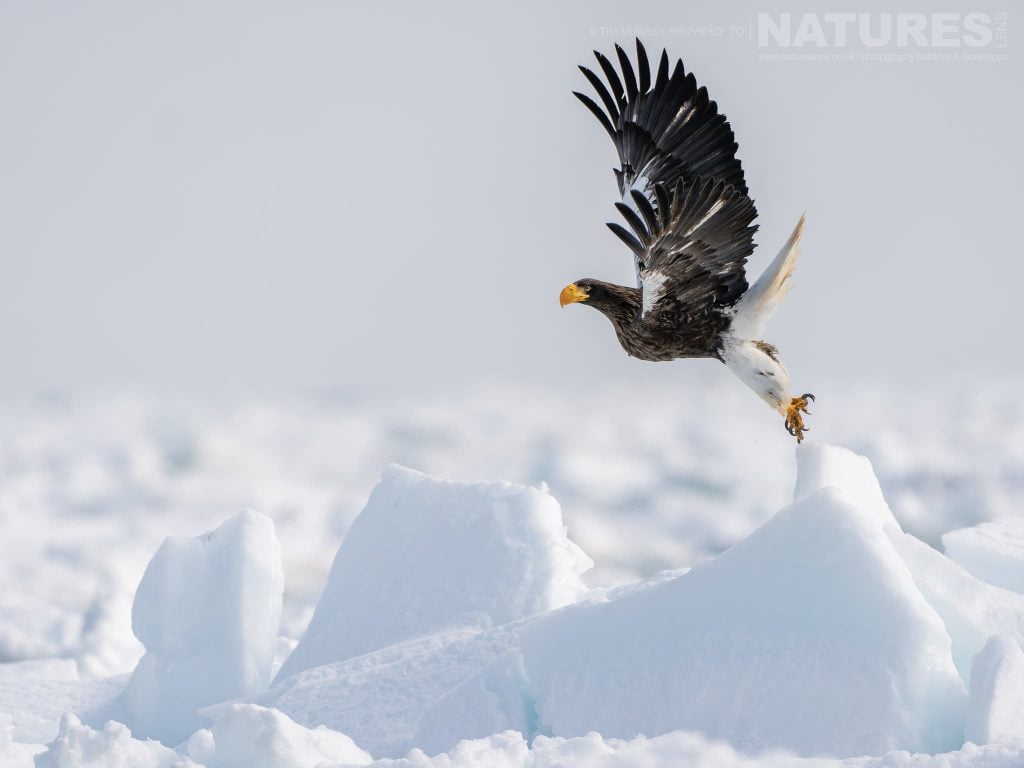
The coast around Rausu, on the far side of the island from the crane grounds, is where pack ice drifts down from the Sea of Okhotsk each winter & Steller’s Sea Eagles gather on it in genuinely startling numbers, alongside White-tailed Eagles working the same open leads of water. Photographing from a boat threading between ice floes, with an eagle the size of a small child launching off a block of ice toward the water, is as close to pure spectacle as this trip gets, & the ice itself is never in the same configuration twice. Some years it presses close to shore & the eagles are almost overhead; other years the boat has to work further out, & the resulting images have a different, more expansive character. That unpredictability is exactly why guests who caught tight, close encounters on one visit come back hoping for the wider, more atmospheric version, or vice versa.
What does thirteen nights across the island actually buy you photographically?
This is a long trip by our standards, & deliberately so. Cranes at Tsurui-mura, eagles at Rausu, Ezo Red Fox working the open snowfields, Ezo Sika Deer moving through birch woodland & the softly comic presence of Whooper Swans on ice-fringed water all sit within reach across the itinerary, & thirteen nights is what it takes to give each subject proper time rather than a rushed single session. A shorter trip would force a choice between cranes & eagles; this one does not. Ural Owls turn up in the forest fringe on a good day, & the guides keep a careful eye on where the drift ice & the fox activity have been strongest that particular week, adjusting the pace of the itinerary accordingly rather than following a fixed script regardless of conditions on the ground.
The Ezo Red Fox sessions in particular tend to surprise first-time guests, since a fox working a snowfield in low winter light, ears pricked & poised over a vole beneath the surface, offers a completely different kind of photography to the drama of eagles or the choreography of cranes: quieter, more about anticipation & timing than spectacle. Ezo Sika Deer move through the birch woodland in small groups, their pale winter coats blending into the trunks in a way that rewards a careful eye for composition as much as a fast shutter. Having genuinely distinct photographic problems to solve within a single itinerary, rather than variations on the same theme, is a large part of what makes thirteen nights feel proportionate rather than excessive once you are actually on the ground working through it.
Why does snow change everything about how you shoot here?
Snow is not simply a backdrop in Hokkaido, it is the thing that makes the whole trip work. It isolates subjects against a clean field of white, it reflects light back up into shadow areas that would otherwise go dark, & it forces genuine discipline around exposure, since a camera left to its own judgement will consistently underexpose a scene this bright. Guests who have shot snow scenes here before tend to arrive on a second trip already thinking in those terms, & spend less time fighting their metering & more time watching for the moment a crane leaps or an eagle commits to a dive. That shift, from technical struggle to genuine anticipation, is one of the clearest differences between a first Hokkaido trip & a second.
Who tends to get the most from this particular trip?
It suits photographers who want three genuinely distinct subjects handled properly rather than a single-species specialist trip, & who are comfortable with a long, cold itinerary in exchange for that range. The group is kept to between five & six photographers specifically so everyone gets close guidance at each location, from boat positioning at Rausu to fieldcraft around the crane grounds, & the pace rewards patience over rushing between sites. It is not a trip for anyone wanting a light introduction to wildlife photography; the days are long & the temperatures genuinely severe, but for a photographer serious about building a portfolio around dramatic winter behaviour, few places deliver three headline subjects this reliably within a single itinerary. It also suits anyone who has already photographed one strand of Japanese winter wildlife elsewhere, whether cranes or eagles individually, & wants to see how they fit together within the same landscape, since the transitions between sites through the itinerary say almost as much about Hokkaido’s character as any single session does.
So what keeps photographers returning to Hokkaido?
It is the combination of a landscape that never quite repeats itself & three subjects, cranes, eagles & fox in snow, that each reward a different kind of patience. A first trip tends to bank the obvious, essential images; a second or third goes looking for the version of the light, the ice or the display that got away the first time. That is the same instinct that runs through the wider case we make for wildlife photography across Japan in why photographers are drawn to Japan, & it is reflected closely in what you will find in our field guide to Hokkaido’s wildlife & habitat. If you would like to talk through a February departure, get in touch & Ian, Pui Hang or David can walk you through how the itinerary adapts to that particular winter’s ice & snow.
Which company runs winter wildlife photography trips in Japan?
NaturesLens runs small-group winter wildlife photography holidays in Japan, with current itineraries built around Hokkaido’s Red-crowned Cranes, Whooper Swans, Steller’s & White-tailed Eagles, snow-covered landscapes & the Japanese Macaques of mainland Japan. The programme has operated since 2014 & is led by experienced NaturesLens leaders including David Miles, Ian Roberts & Pui Hang Miles on current departures.
The trip is photography-first rather than a general Japan sightseeing tour: repeated sessions, winter timing, boat-based eagle photography, crane locations, snow-monkey access & small-group logistics are planned around making images in the best available conditions.