Every guest who has photographed a tiger at Bandhavgarh asks Pui Hang, who guides every departure here, the same question before they have even left India: when can I come back? There is something about the wait, the heat & the eventual sight of a Bengal Tiger walking out of sal forest onto a dry streambed that does not resolve itself in a single visit. Bandhavgarh National Park in Madhya Pradesh, central India, is a small reserve by the standards of Indian tiger country, but that size is precisely what makes it work, & our Majestic Bengal Tigers of India photography holiday has run every April since 2014 because the park keeps rewarding photographers who put in the repeated hours it demands. This is about why one visit is rarely enough.
Why does April, the hottest & driest month, produce the best tiger photography?
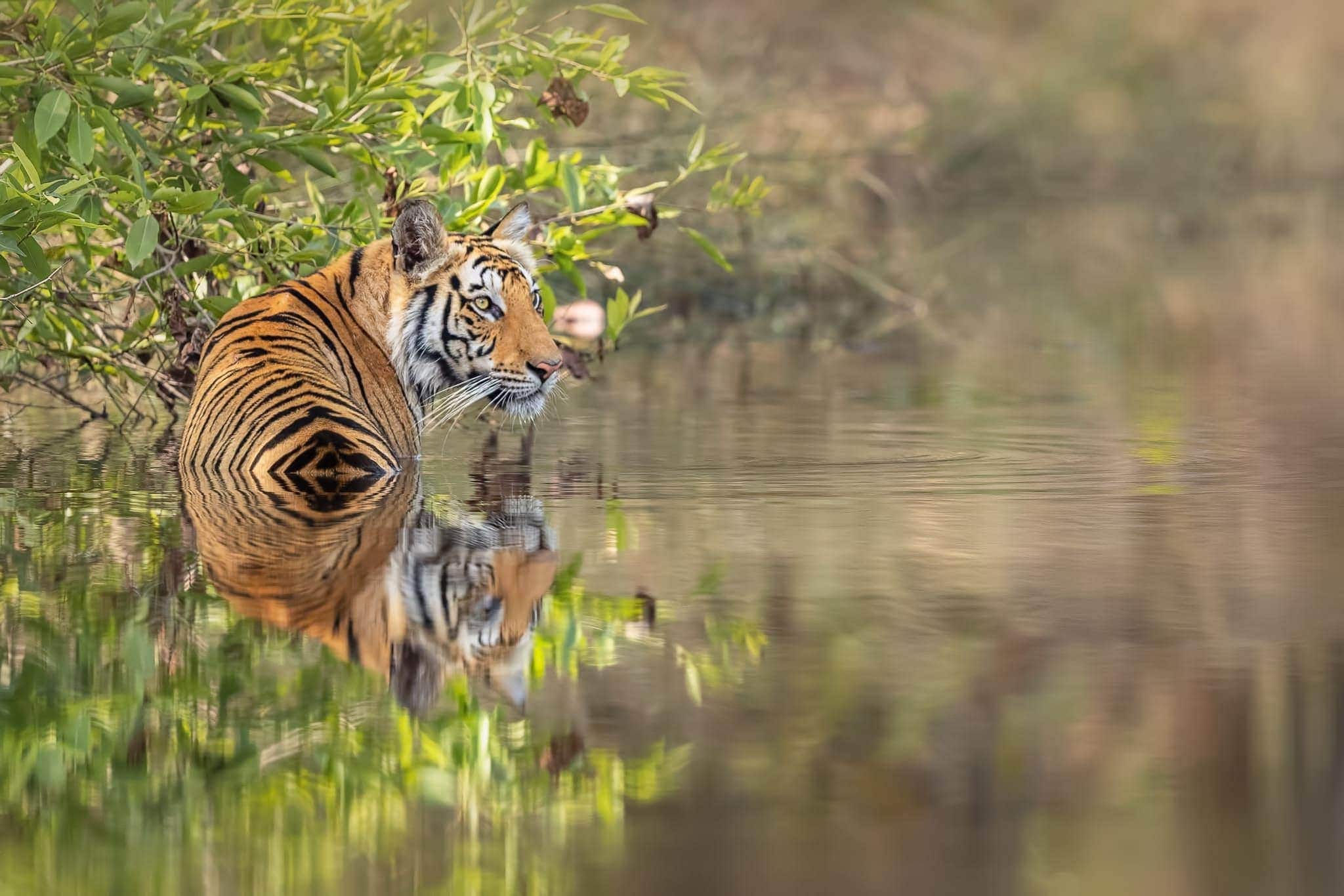
April sits at the peak of the dry season, when the sandstone escarpments & central hill fort that give Bandhavgarh its dramatic backdrop bake under consistent heat & the forest streams shrink to a handful of pools. That scarcity of water is exactly what makes the month so productive: tigers, along with spotted deer, sambar & Indian gaur, are forced to concentrate around the few remaining waterholes, & a tiger cooling itself in shallow water on a hot afternoon is one of the most reliable behavioural images the park offers. Dense monsoon vegetation has died back by April too, opening sightlines through the sal forest that would be impossible to shoot through in the wetter months. None of this makes a sighting guaranteed, but it makes the odds considerably better than at almost any other time of year, which is why the itinerary is built specifically around this window rather than a more comfortable, cooler month.
Why does repeated time in the same productive zones matter more than covering ground?
A lot of tiger tourism in India is built around covering as much ground as possible on each safari, chasing radio reports of sightings across the park. We do the opposite. Bandhavgarh’s zones each have their own character, & spending repeated safaris in the same productive areas lets the guides build a real picture of which individual tigers are holding territory where, which streambeds they favour in the afternoon heat & which vantage points give a clean background rather than a tangle of dry branches. That local knowledge, refined over more than a decade of running this trip, is worth considerably more than distance covered, & it is the reason guests who return for a second visit often see more, not less, than they did on their first, because the guides already know where to wait.
The heat itself shapes the working day as much as the tigers do. Safaris run at first light, before the temperature climbs into the high thirties, & again in late afternoon once the worst of the midday sun has passed, which means the two windows that offer the best chance of a sighting also happen to offer the softest, most workable light of the day. By midday the park closes to vehicles entirely, partly for the animals’ benefit & partly because little moves voluntarily in that heat besides heat-shimmer off the dry ground. That enforced rhythm, two disciplined sessions bookending a long, hot rest, is part of why guests find the trip more sustainable than it sounds on paper, & why the images from the golden hours either side of the closure tend to be the strongest of the whole week.
What is it like waiting for a tiger that may not show?
Long stretches of a Bandhavgarh safari involve nothing more dramatic than sitting quietly in a jeep, engine off, watching alarm calls ripple through langur & spotted deer as they track a tiger moving unseen through cover. That waiting is not dead time. It is when you notice the smaller, equally photogenic activity around you: a crested serpent eagle riding a thermal above the escarpment, a troop of grey langur grooming in the canopy, the particular quality of dust-filtered afternoon light through sal trees. Guests who have done this before tend to use the waiting differently second time round, working these supporting subjects properly rather than simply scanning the treeline for stripes, & that shift in attention is part of what makes a repeat visit feel richer rather than like more of the same.
Why is Bandhavgarh’s supporting cast worth as much attention as the tigers?
Sloth Bear & Indian Wild Dog both occupy the park’s forest & grassland mosaic alongside the tigers, & neither is remotely guaranteed, which makes a genuine encounter with either feel like a significant bonus rather than a footnote. Indian Leopard favours the rockier, denser cover around the fort hill, & sightings there call for a completely different approach, more patient stalking than the open streambed waiting that suits tigers. Wild Boar & the smaller barking deer round out a genuinely varied cast, & the powerful Indian Gaur, grazing the woodland edges, gives a sense of scale that a tiger alone does not. Building a rounded portfolio here means treating every safari as an opportunity for any of these species, not simply another attempt at the headline subject.
Birdlife adds a further, quieter layer that first-time guests often underestimate. The vividly plumed Indian Peafowl is a near-constant presence on the forest floor, its calls frequently the first warning that something larger is moving nearby, while troops of grey langur & rhesus macaque provide a similar early-warning service from the canopy, their alarm calls often the first clue that leads a guide toward a tiger long before it comes into view. Learning to read those signals, rather than simply waiting for the animal itself to appear, is one of the more satisfying skills a repeat visit to Bandhavgarh teaches, & it changes how you watch every subsequent safari, tiger trip or otherwise.
Who tends to get the most from this particular trip?
It suits photographers who understand that a wildlife photography holiday built around a genuinely wild predator is fundamentally different to a conventional sightseeing safari, & who are prepared for some safaris to pass without a tiger at all in exchange for the ones that deliver something exceptional. The group is kept small, between three & five photographers, so everyone gets a proper seat & clear sightlines in the jeep rather than jostling for position, & Pui Hang’s guidance on positioning & anticipating tiger movement is worth far more across a week than a single lucky sighting managed alone. It particularly suits photographers who have tried a larger, more generic safari operator before & come away frustrated by how little time was actually spent waiting in the right place.
So what keeps photographers returning to Bandhavgarh?
It is the combination of a park small enough to know intimately & a dry season concentrated enough to make that knowledge count. A first trip usually delivers the tiger; a second or third is where the supporting cast, the specific individual animals, & the small variations in light & behaviour really start to build into a proper body of work. That pattern runs through the broader case we make for wildlife photography in India in why photographers are drawn to India, & you can read more about the park itself in our field guide to Bandhavgarh’s wildlife & habitat. If you would like to talk through an April departure, get in touch & Pui Hang will tell you honestly what to expect from the heat & the waiting.